[Stanford CS144] Lab 4 Record
The content below was generated entirely by machine translation. Please verify its accuracy. If anything is unclear, consult the Chinese source version.
Implementing the TCP State-Transition Diagram
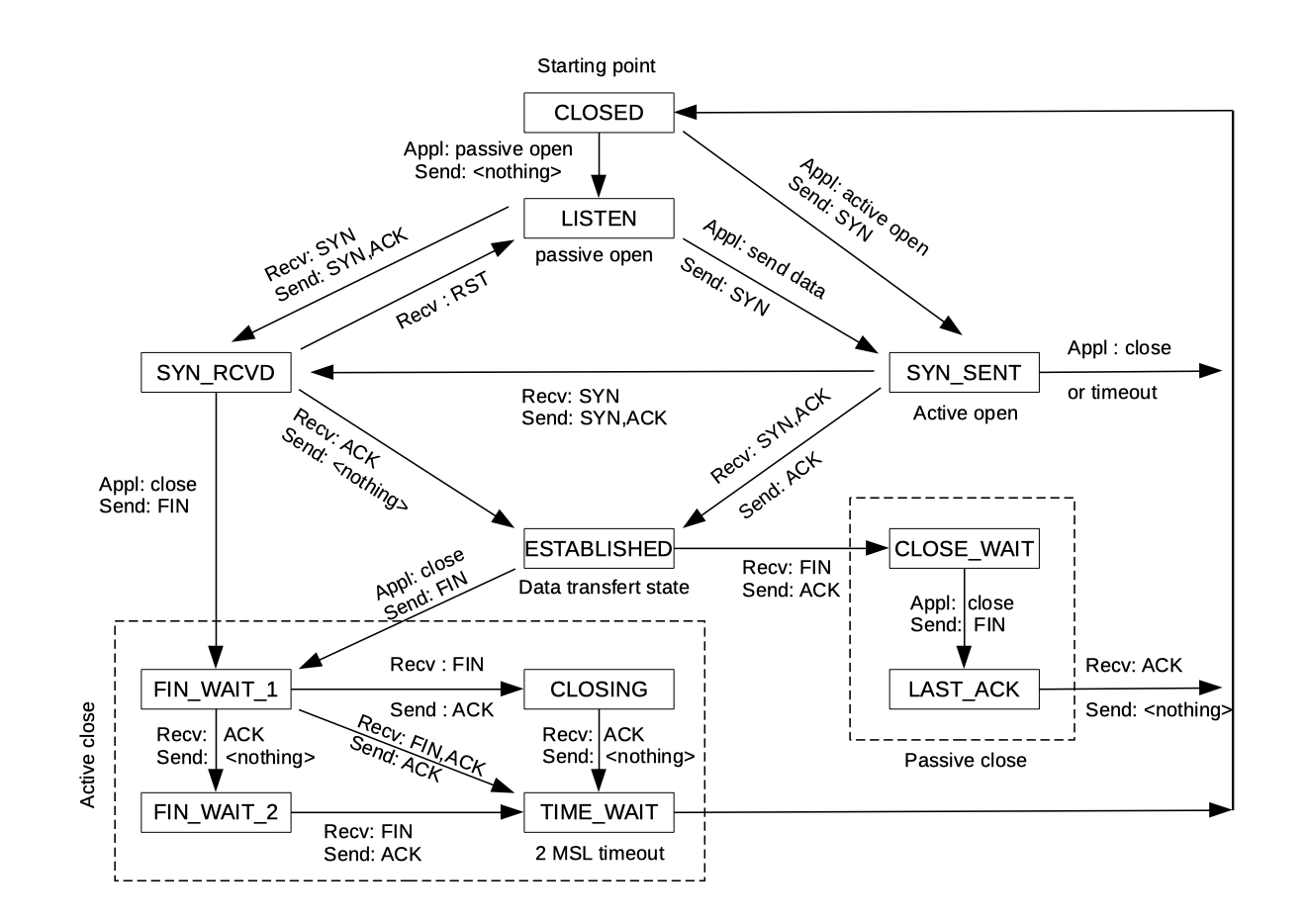
The main purpose of Lab 4 is to combine the receiver and sender from the previous labs into a complete TCP protocol stack. Therefore, it is important to become familiar with the TCP state-transition diagram.
Here is a TCP state-transition diagram:
Establishing a TCP Connection
As shown above, TCP has two ways to establish a connection. The first is an active connection, in which a SYN packet is sent to the peer. The second is a passive connection, in which a SYN+ACK packet is sent in response after receiving a SYN packet.
Active Connection
For an active connection, we need to implement connect():
1 | void TCPConnection::connect() { |
The shutted variable indicates whether the connection has been closed and is used later in active(). We previously implemented TCPSender::fill_window(), which records whether the connection has been established and automatically sends a SYN packet if it has not.
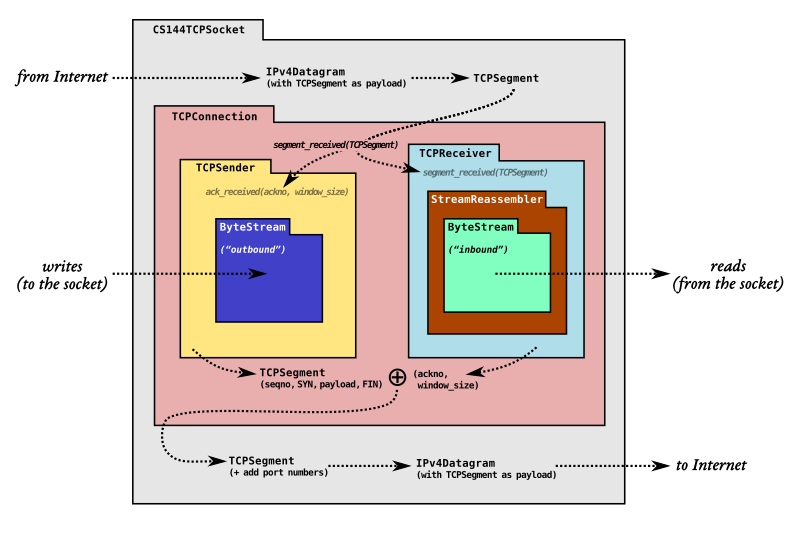
However, TCPSender::fill_window() only pushes the packets to be sent into its _segments_out queue. We need to put these packets into TCPConnection’s _segments_out, so that Sponge will send them using IP.
Therefore, one purpose of send_sender_segs() after fill_window() is to move the packets in _segments_out into TCPConnection’s _segments_out.
Of course, TCPSender does not know some header information when sending a packet, such as win and ackno. The former indicates how much data TCPReceiver can still receive, while the latter indicates how much data TCPReceiver has already received. Therefore, we also need to fill in this information in send_sender_segs().
One relatively tricky part is the range of win in the header. The definition in TCPHeader is:
1 | uint16_t win = 0; //!< window size |
This is an unsigned 16-bit integer. However, TCPReceiver::window_size() returns a 64-bit integer:
1 | size_t TCPReceiver::window_size() const { |
If we directly assign the result of window_size() to win, overflow may occur, so assign it as follows:
1 | seg.header().win = min(_receiver.window_size(), (size_t)numeric_limits<uint16_t>::max()); |
Passive Connection
Looking again at the state diagram, if the current state is LISTEN, then after receiving a SYN and replying with SYN+ACK, the connection is established.
But how do we determine the LISTEN state? A convenient method is to use the TCPState class provided by Sponge.
It can determine not only the overall state of TCPConnection, but also the states of TCPSender and TCPReceiver separately.
Here, LISTEN is an overall state.
In segment_received(), we can determine whether to perform a passive connection as follows:
1 | bool passive_connect = (state() == TCPState::State::LISTEN && seg.header().syn); |
If a passive connection is needed, write:
1 | // Passively establish a connection when in the listen state. |
At this point, the connection has been established successfully. For every newly arriving packet, we only need to call _receiver.segment_received() and _sender.ack_received() in segment_received() to update the information and maintain the connection (_sender.ack_received() lets the sender know what the peer received, so it can retransmit missing data).
Closing a TCP Connection
Compared with establishing a connection, closing one is more complicated, and a “perfect” close cannot always be guaranteed.
In computer networking, a famous thought experiment describing why TCP cannot close a connection perfectly is the Two Generals’ Problem. The description on Wikipedia[1] is as follows:
Two armies led by different generals are preparing to attack a fortified city. The armies camp in two valleys near the city. Since another valley separates the two hills, the generals can communicate only by sending messengers through the valley. However, the valley is occupied by the city’s guards, who may capture any messenger passing through it.
Although the armies have agreed to attack simultaneously, they have not agreed on an attack time. To attack successfully, both armies must attack at the same time. If only one army attacks, it will be defeated, so the generals must agree on an attack time and ensure that the other general knows that they agree to the plan.
General A first sends a messenger to General B saying, “Attack at 9:00 on August 4.” After sending the messenger, General A does not know whether it successfully passed through enemy territory. Worried about becoming the only attacking army, General A may hesitate to attack as planned.
To remove this uncertainty, General B can send General A a confirmation saying, “I received your message and will attack at 9:00 on August 4,” but the messenger carrying the confirmation may also be captured. Worried that General A did not receive the confirmation and will retreat, General B may hesitate to attack as planned.
Sending another confirmation seems to solve the problem—General A can send a new messenger saying, “I received your confirmation to attack at 9:00 on August 4.” But General A’s new messenger may also be captured. Clearly, no number of confirmations satisfies the second condition: both parties must ensure that the other has agreed to the plan. The generals will always doubt whether the last messenger they sent successfully crossed enemy territory.
TCP closing has the same problem. After A sends a disconnection message, B can send an ACK packet to indicate that it received the message. However, B does not know whether A received the ACK, and therefore worries about whether A will close normally. A can of course send another ACK, but this falls into the Two Generals’ dilemma.
Repeatedly sending confirmations may seem to reduce errors, but the TCP protocol does not reply to an ACK packet (a packet containing no actual data, only an ACK) with another ACK, so we need another solution.
As with connection establishment, we can discuss active and passive closing separately.
Passive Close
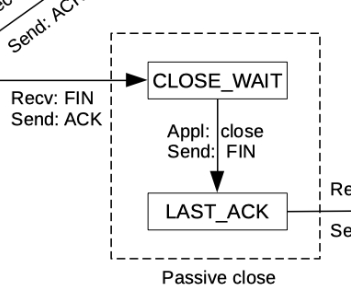
Compared with active closing, passive closing is relatively simple, so let us discuss it first.
The only difference between passively and actively closing endpoints is the order in which they send FIN packets. An active closer sends a FIN packet after sending all TCP packets produced by its own outgoing byte stream.
Although one side has sent FIN at this point, this does not mean that the connection is closed, because the passive side may still have data to send. After it finishes sending, the passive side also sends FIN and enters the LAST_ACK state.
The sole purpose of this state is to wait for the other side to acknowledge FIN. If the active side does not acknowledge it, the passive side must keep sending FIN to ensure that the peer received it.
After receiving the ACK, it can close directly.
Active Close
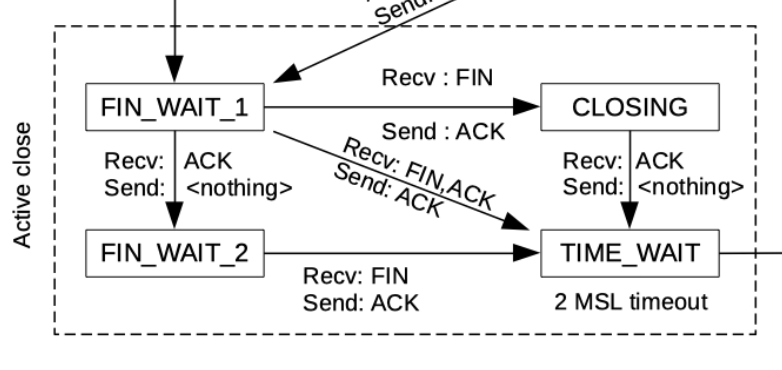
When the outgoing byte stream has been completely sent, one endpoint sends FIN and enters FIN_WAIT_1. This indicates that one direction of the TCP connection has closed: the current endpoint only receives data and will not send new data. After the peer acknowledges the FIN, the endpoint changes to FIN_WAIT_2 and waits for the peer to finish sending its data.
After receiving and acknowledging the peer’s FIN, the endpoint enters TIME_WAIT. This state means:
- The endpoint has completed reassembling the incoming byte stream, and the incoming byte stream is closed.
- The outgoing byte stream has been completely sent and acknowledged.
Although, after entering TIME_WAIT, we cannot know whether the peer received our acknowledgment of its FIN, if it did not, it will most likely retransmit FIN within a certain time (TCP’s timeout retransmission mechanism is implemented by TCPSender).
Although the network may be congested, if we wait (linger) for a relatively long time and the peer does not retransmit, it is likely that the peer received the acknowledgment and closed the connection.
The assignment specifies this waiting time:
it has been at least 10 times the initial retransmission timeout (
cfg.rt_timeout) since the local peer has received any segments from the remote peer.[2]
With the default cfg.rt_timeout, the total waiting time is at least 10 seconds.
Implementing Passive Close
Earlier we mentioned that the passive side does not need to wait, or linger. It can be implemented as follows:
1 | // In segment_received. |
Implementing Active Close
Because _linger_after_streams_finish defaults to true, if it was not set to false in the preceding check, we are the active closer.
The only function in TCPConnection that can obtain the current time is tick(). To implement directly closing the connection after a timeout, add the following to tick():
1 |
|
After adding a great many details, the tests pass. (The assignment’s collaboration policy says that the code cannot be made public, so only some code snippets are included here.) The test result is:
1 | ./tcp_benchmark |
To be honest, the speed is still relatively slow. The main reason can also be seen from the earlier flame graph: string copying and processing. After optimizing it, I may write another blog post introducing the optimization process and content.