
[MIT 6.s081] Xv6 Lab 6: Copy-on-Write Record
The content below was generated entirely by machine translation. Please verify its accuracy. If anything is unclear, consult the Chinese source version.
Update on 2022/9/14: I recently put the lab code on GitHub. If you need a reference, you can find it here:
https://github.com/ttzytt/xv6-riscv
The different branches contain the different labs.
Lab 6: Copy-on-Write Fork for xv6

The lab description itself is remarkably brief because its main explanation appears immediately beforehand:
The problem
The fork() system call in xv6 copies all of the parent process’s user-space memory into the child. If the parent is large, copying can take a long time. Worse, the work is often largely wasted; for example, a fork() followed by exec() in the child will cause the child to discard the copied memory, probably without ever using most of it. On the other hand, if both parent and child use a page, and one or both writes it, a copy is truly needed.
The solution
The goal of copy-on-write (COW) fork() is to defer allocating and copying physical memory pages for the child until the copies are actually needed, if ever.
COW fork() creates just a pagetable for the child, with PTEs for user memory pointing to the parent’s physical pages. COW fork() marks all the user PTEs in both parent and child as not writable. When either process tries to write one of these COW pages, the CPU will force a page fault. The kernel page-fault handler detects this case, allocates a page of physical memory for the faulting process, copies the original page into the new page, and modifies the relevant PTE in the faulting process to refer to the new page, this time with the PTE marked writeable. When the page fault handler returns, the user process will be able to write its copy of the page.
COW fork() makes freeing of the physical pages that implement user memory a little trickier. A given physical page may be referred to by multiple processes’ page tables, and should be freed only when the last reference disappears.
In short, we need to implement the copy-on-write technique used by UNIX. Without COW, fork() copies all memory belonging to the parent into the child’s address space. This consumes an enormous and unacceptable amount of time for a large process.
Much of the memory copied during fork() is never used. For example, the usual UNIX process-creation sequence first invokes fork() and then exec(). All data copied from the parent is immediately discarded by exec().
There is only one situation in which memory truly needs to be copied during a fork: a write. If the parent or child attempts to write a value at an address, the corresponding page frame must be copied so that the write does not change memory observed by the other process.
Copy-on-write implements precisely this behavior. Mark shared parent and child PTEs as not writable. When either process attempts to write a shared page, the CPU generates a page fault. usertrap() handles it by copying the shared frame for the writing process and marking that new frame writable.
After COW is implemented, several processes may share one physical page frame. That frame can be truly released only after every process has stopped using it.
We can now follow the hints one at a time.
uvmcopy()
Modify
uvmcopy()to map the parent’s physical pages into the child, instead of allocating new pages. Clear PTE_W in the PTEs of both child and parent.
Modifyuvmcopy()so that the parent’s physical memory is mapped directly into the child’s virtual address space rather than allocating new memory. Clear PTE_W in both parent and child PTEs.
After this change, the parent and child effectively share memory. We want a write by either process to cause a page fault, so PTE_W must be cleared:
1 | // Given a parent process's page table, copy |
usertrap()
Modify
usertrap()to recognize page faults. When a page-fault occurs on a COW page, allocate a new page with kalloc(), copy the old page to the new page, and install the new page in the PTE with PTE_W set.
Modifyusertrap()to handle page faults. When the fault occurs on a COW page, allocate a new physical page, copy the original frame into it, and install the new page with PTE_W set.
As in the lazy-allocation lab, we need a helper that determines whether a virtual address is a valid, not-yet-copied COW page. The hint says that a new physical page may be allocated only when the fault occurs on a COW page. How can we distinguish one? We can use the reserved bits in a RISC-V PTE. Each PTE has ten flag bits; eight have defined meanings, leaving bits 8 and 9 reserved:

These RSW bits are available to software.
Define bit 8 as an indicator that the frame is a COW page. Add the following macro in kernel/riscv.h. This also explains why uvmcopy() above sets PTE_C in the child PTE:
1 |
The helper that detects an uncopied COW page follows. As in the lazy-allocation lab, I placed it in vm.c:
1 | int uncopied_cow(pagetable_t pgtbl, uint64 va){ |
We can now modify usertrap():
1 | …… |
Unlike the lazy-allocation lab, only scause 15 is handled. According to the RISC-V documentation:
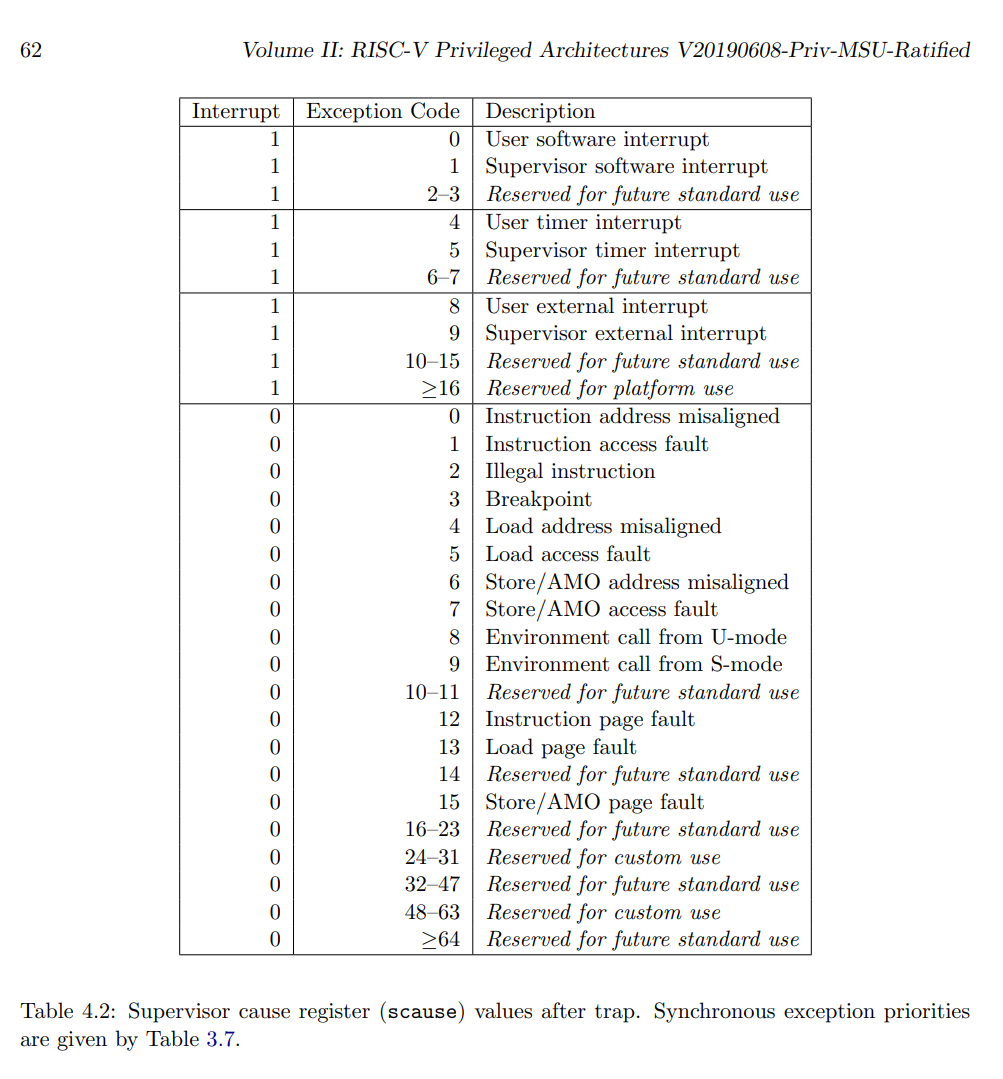
An scause of 15 means a page fault caused by an attempted write.
After determining that the current page is a valid COW page, allocate physical memory for it. As in the preceding lab, I wrapped this work in cowalloc():
1 | int cowalloc(pagetable_t pgtbl, uint64 va){ |
One detail is critical: memmove() must precede uvmunmap(). This took me a long time to debug. After uvmunmap(), the parent’s physical page may have been released, so a later memmove() would read invalid data.
After reading this function, another problem may be apparent. The parent’s page frame might be shared by more than one child. Calling uvmunmap() with do_free equal to one may release the parent frame while other processes still use it.
This leads to the next hint.
Reference count
Ensure that each physical page is freed when the last PTE reference to it goes away – but not before. A good way to do this is to keep, for each physical page, a “reference count” of the number of user page tables that refer to that page. Set a page’s reference count to one when
kalloc()allocates it. Increment a page’s reference count when fork causes a child to share the page, and decrement a page’s count each time any process drops the page from its page table.kfree()should only place a page back on the free list if its reference count is zero. It’s OK to keep these counts in a fixed-size array of integers. You’ll have to work out a scheme for how to index the array and how to choose its size. For example, you could index the array with the page’s physical address divided by 4096, and give the array a number of elements equal to highest physical address of any page placed on the free list bykinit()in kalloc.c.
We need reference counts to solve the problem. Every page frame has a count recording how many COW mappings refer to it. Only when no COW page still uses a frame can it actually be freed, somewhat like the behavior of close(). kalloc() sets the reference count of a newly allocated page to one. kfree() first decrements the count and frees the frame only when the result reaches zero.
We also need a way to store these counts. Because every page-frame start address is divisible by 4096, divide the physical address of a frame by 4096 to obtain its index.
This gives the following macros and array:
1 |
|
The following diagram helps explain the calculation:
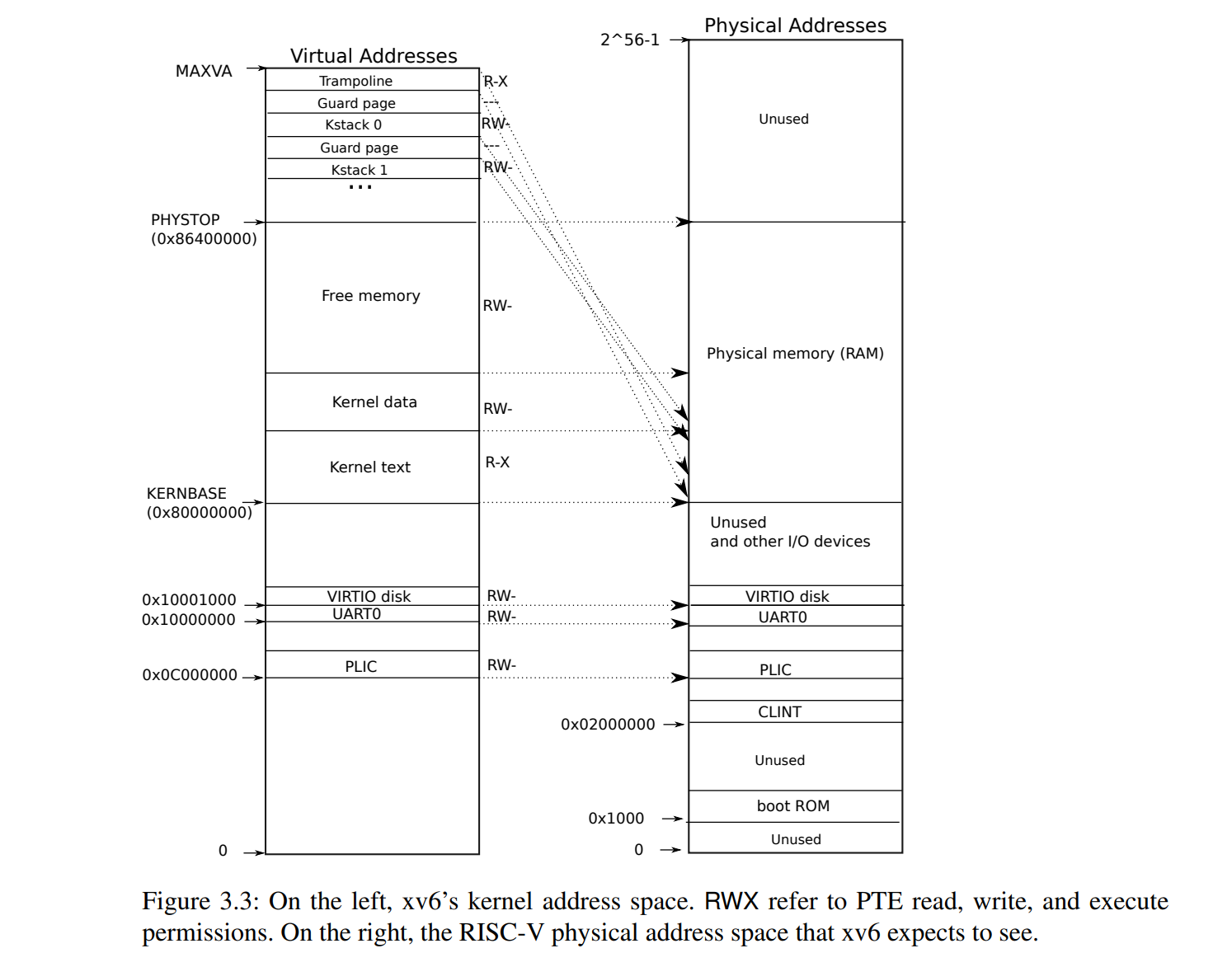
PHYSTOP and KERNBASE mark the beginning and end of the physical-memory range, so subtract KERNBASE from pa before dividing by PGSIZE.
At first I wondered where this array would itself be stored in kernel memory. The implementation of kinit() gives the answer:
1 | void |
Here, end is the beginning of Free memory in the diagram and is defined in kernel.ld. The kernel’s own code and data, including this array, live in kernel text and kernel data. kalloc() allocates only from the range end through PHYSTOP.
We can now modify the functions in kalloc.c around the reference counts.
First, kalloc():
1 | void * |
Next, kfree():
1 | void |
refcnt_lock is initialized in kinit():
1 | void |
The lock is required because several processes referencing the same frame may call kfree() simultaneously. Concurrent decrements without synchronization could produce an incorrect result.
In uvmcopy(), increment the reference count for the parent’s page frame because one additional process now shares it. This is the refcnt_inc() call after mappages(), whose definition is:
1 | void refcnt_inc(void* pa){ |
This completes the reference-counting portion.
One final hint remains.
copyout()
The reason for modifying copyout() resembles the previous lab. Some system calls write data into COW pages. Because PTE_W is clear on those pages, the write generates a page fault. trap.c treats an exception occurring inside a system call as a kernel fault and panics. Therefore, if copyout() discovers a COW page, it should allocate a private page directly.
Unlike the lazy-allocation lab, copyin does not need a modification here. copyin() can read the physical frame shared by the parent. In the lazy-allocation lab, by contrast, the frame being read had no physical address at all and therefore could not be accessed.
Modify copyout() as follows:
1 | // Copy from kernel to user. |
When writing this function, the order of cowalloc() and walkaddr() is crucial. I originally reversed them and spent a long time finding the problem. Calling walkaddr() before cowalloc() returns the physical address of the parent’s shared frame.
The later write would then modify that shared address, corrupting data used by other processes.
Calling walkaddr() after cowalloc() instead returns the newly allocated physical address. The write goes to a frame owned by the current process and cannot affect any other process.
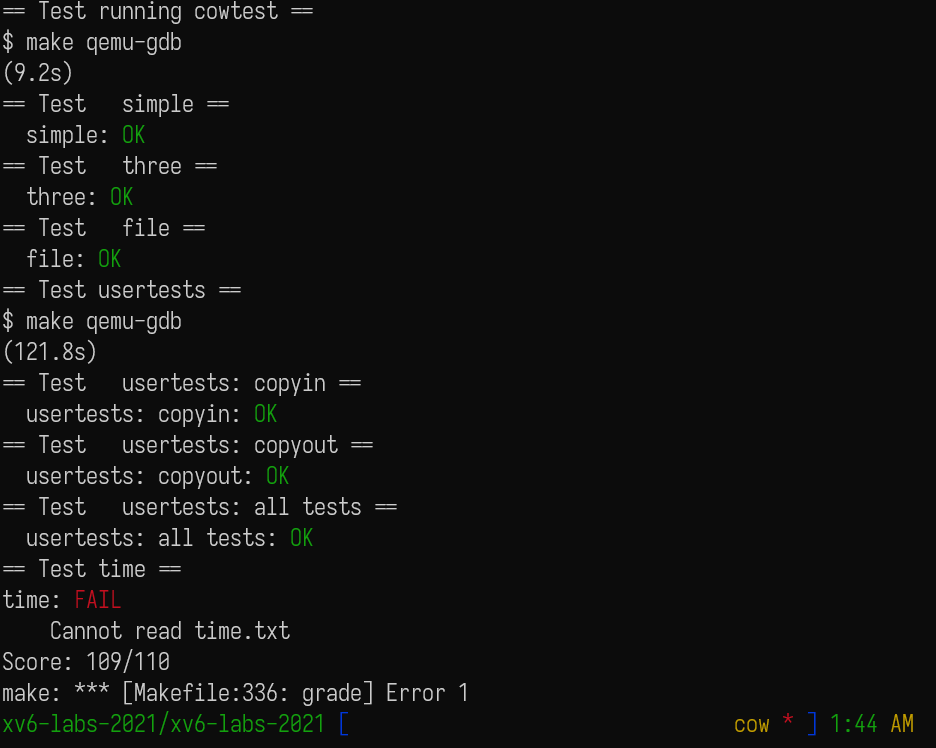
With this function complete, the lab passes. I wish everyone working on it an early AC:
Summary
I cannot understand why GDB failed to reveal several foolish mistakes even after so much debugging. I began to suspect the compiler itself. In the future, I need to reason through the design before writing it. If the implementation is wrong and my debugging assumptions follow the same wrong direction, the bug will never be found.


![[Stanford CS144] Lab 4 Record](/img/CS144/tcp%E7%8A%B6%E6%80%81%E6%B5%81%E8%BD%AC%E5%9B%BE.jpg)
![[Stanford CS144] Lab 0–Lab 3 Lab Notes](/img/CS144/sponge%E7%BB%93%E6%9E%84%E5%9B%BE.svg)