
[MIT 6.s081] Xv6 Lab 4: Traps Record
The content below was generated entirely by machine translation. Please verify its accuracy. If anything is unclear, consult the Chinese source version.
Preface: today is 2022/7/25, so first I want to celebrate the blog having operated for 100 days.
Update on 2022/9/14: I recently put the lab code on GitHub. If you need a reference, you can find it here:
https://github.com/ttzytt/xv6-riscv
The different branches contain the different labs.
Lab 4: traps
RISC-V assembly
Postponed for now.
Backtrace
Implement abacktrace()function. When a program calls it, the function should print that program’s “function call order”—that is, all function addresses currently on the stack, in sequence.
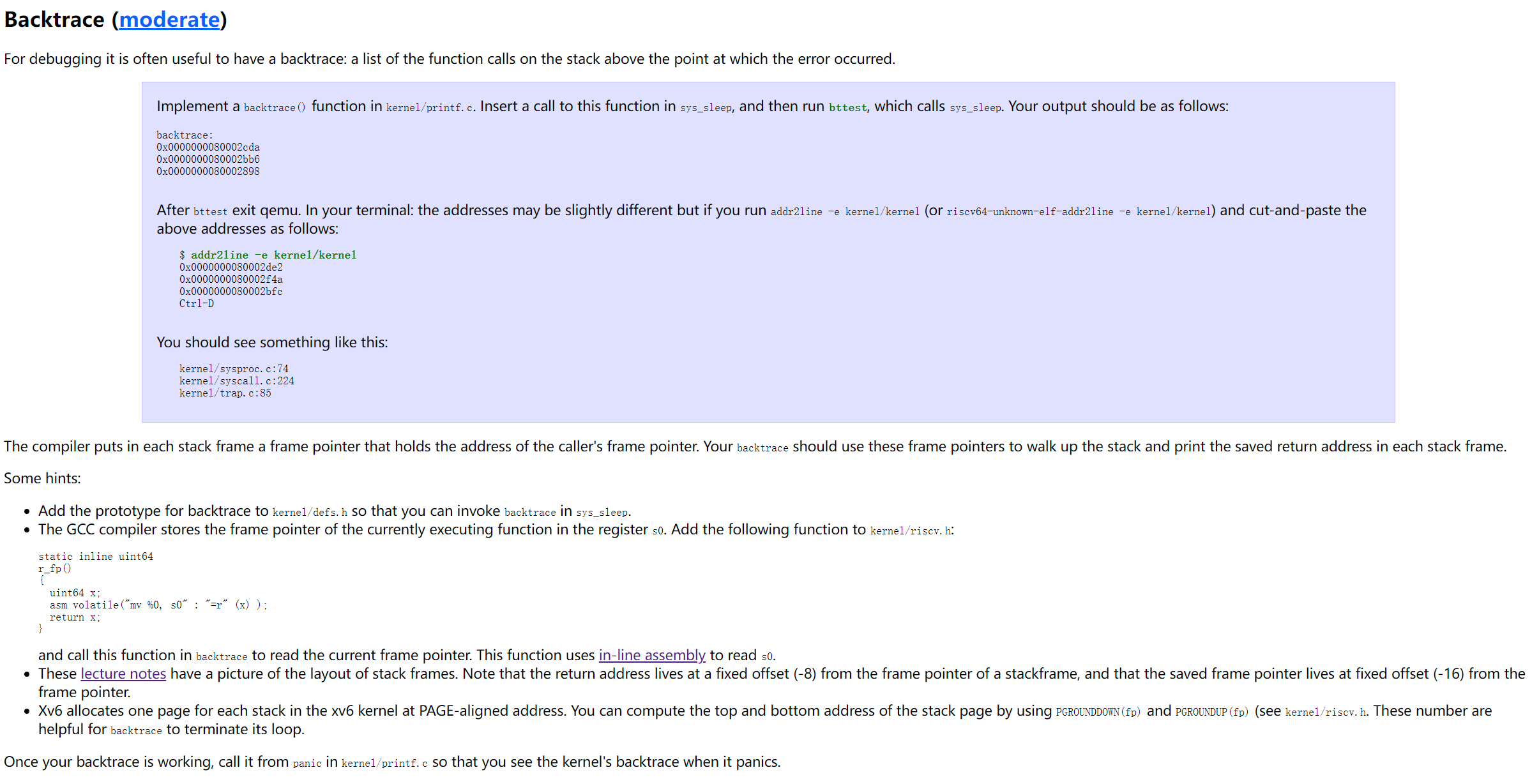
The most important prerequisite for this exercise is understanding the process of a function call. For details, refer to this article that I wrote earlier.
I have placed the most important diagram and video from that article below. This is definitely not padding the word count. If you were previously familiar with function calls but have forgotten the details, these should make them easy to recall.
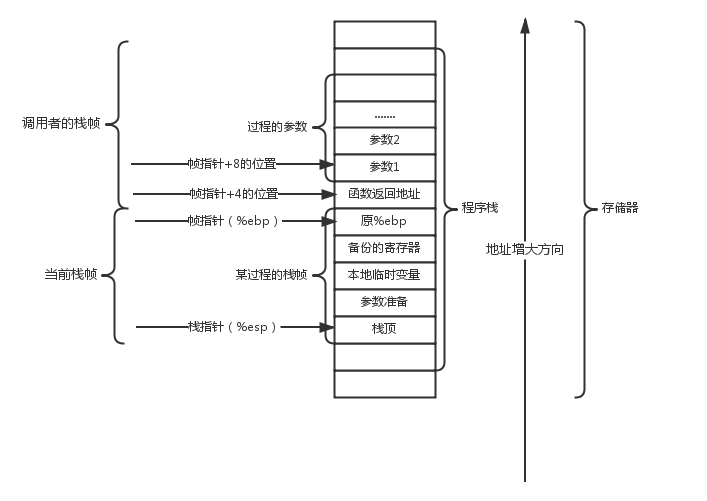
The lab asks us to print a chain of function calls.
For example, consider this program:
1 | int third(int x){ |
The correct output from backtrace() should be:
1 | 114 |
In other words, recursively print the addresses of the calling functions.
Every stack frame stores the current function’s return address—the location to which execution should return after that function finishes.
We can therefore print the return address from each frame. We also need a variable storing the current frame pointer. Adding the appropriate offset to this pointer obtains the preceding function’s frame pointer, allowing us to print its return address as well.
One detail is that my earlier article used an x86-64 processor, where the frame pointer is named the bp, or base pointer, register. In RISC-V, the fp, or frame pointer, register performs the same job.
The location to which fp points in RISC-V is also slightly different from the x86 location. The following diagram shows the layout.[1]
1 | High addresses |
In RISC-V, fp points to a location immediately above the current frame’s return address, meaning a higher address. In x86, bp points to the saved bp of the preceding stack frame.
This probably results from a difference in how x86 and RISC-V define a stack frame. In RISC-V’s definition, the return address is part of the current stack frame, which honestly seems like the more reasonable design to me.
Although fp always lets us find a function’s return address, we still need to obtain the current value of fp. This requires inline assembly in C. We can put the following helper in kernel/riscv.h:
1 | static inline uint64 |
The basic format of GCC extended inline assembly is:
1 | asm asm-qualifiers ( AssemblerTemplate |
Here, asm begins the inline assembly and asm-qualifiers describes its properties. The volatile qualifier used above tells GCC not to optimize this assembly away.
In ("mv %0, s0" : "=r" (x)), mv %0, s0 is an assembly template rather than final assembly, somewhat like a C++ template. During compilation, GCC replaces %0 with the register that contains the variable selected by the later constraint, : "=r" (x), which is x here.
The string "=r" is a constraint. The r says that x may reside in any general-purpose register, while the equals sign says that this operand is written by the assembly.
Many constraints besides r exist.[2] For example, m allows the variable to reside in memory. For additional constraints, see the GCC documentation.
The GCC extended-assembly documentation also explains this feature in considerable detail.
Overall, r_fp() reads register s0, stores the value in x, and returns x.
But we want the fp register, so why does the function use s0? The following table provides the answer.[3]
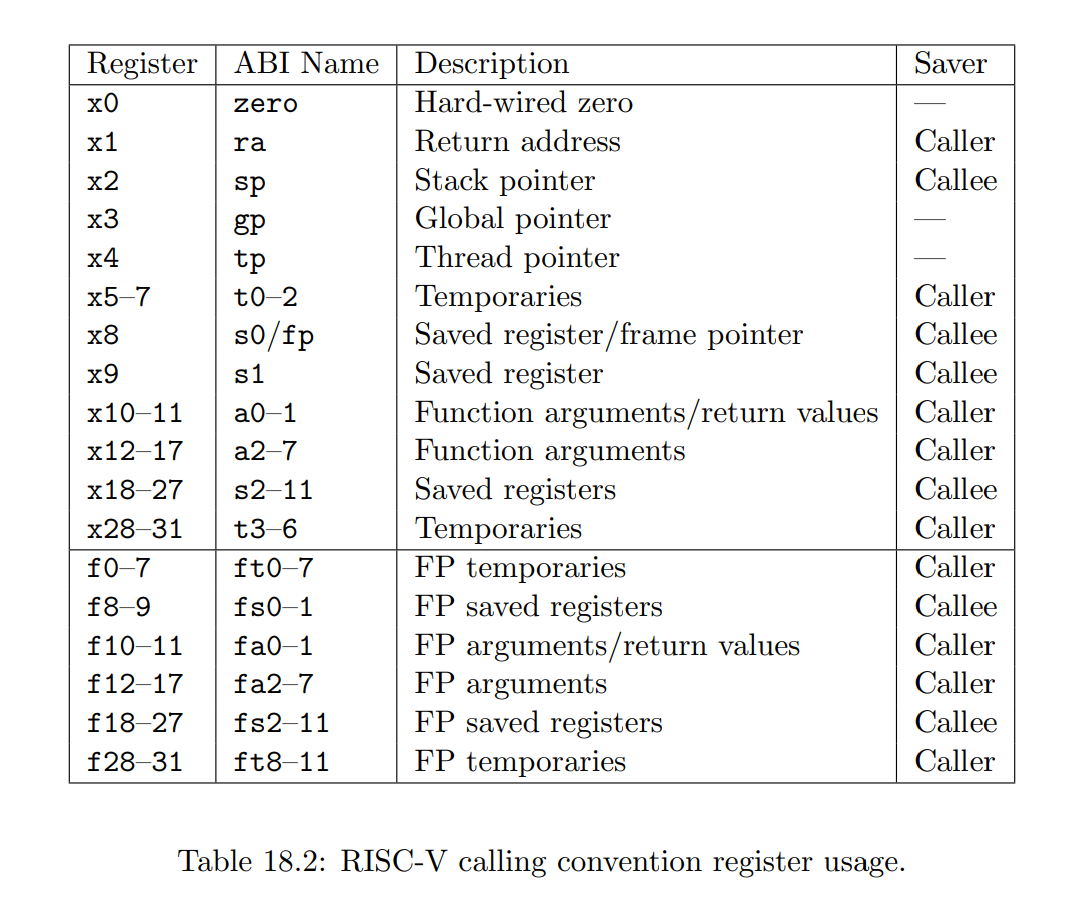
The ABI Name column shows that s0 is an alias for fp.
With this knowledge, we can write backtrace():
1 | void |
Some expressions here look unusual, almost like negative array indices. In fact, cur_frame[-1] is equivalent to *(cur_frame - 1). Because cur_frame is a pointer to 64-bit values, this reads the data eight bytes before cur_frame.
PGROUNDDOWN and PGROUNDUP are used because a chain of function calls fits within at most one page. If recursive printing goes outside that page’s range, we have reached the bottommost function and can stop.
Finally, add backtrace() to the sys_sleep() system call as requested, and this part is complete.
Alarm
Implement asigalarm(interval, handler)system call that executeshandleronce everyintervalclock ticks. Also implementsigreturn(): when the handler calls it, execution of the handler should stop and the normal instruction sequence should resume. Passing zero for both arguments ofsigalarmdisables the handler.
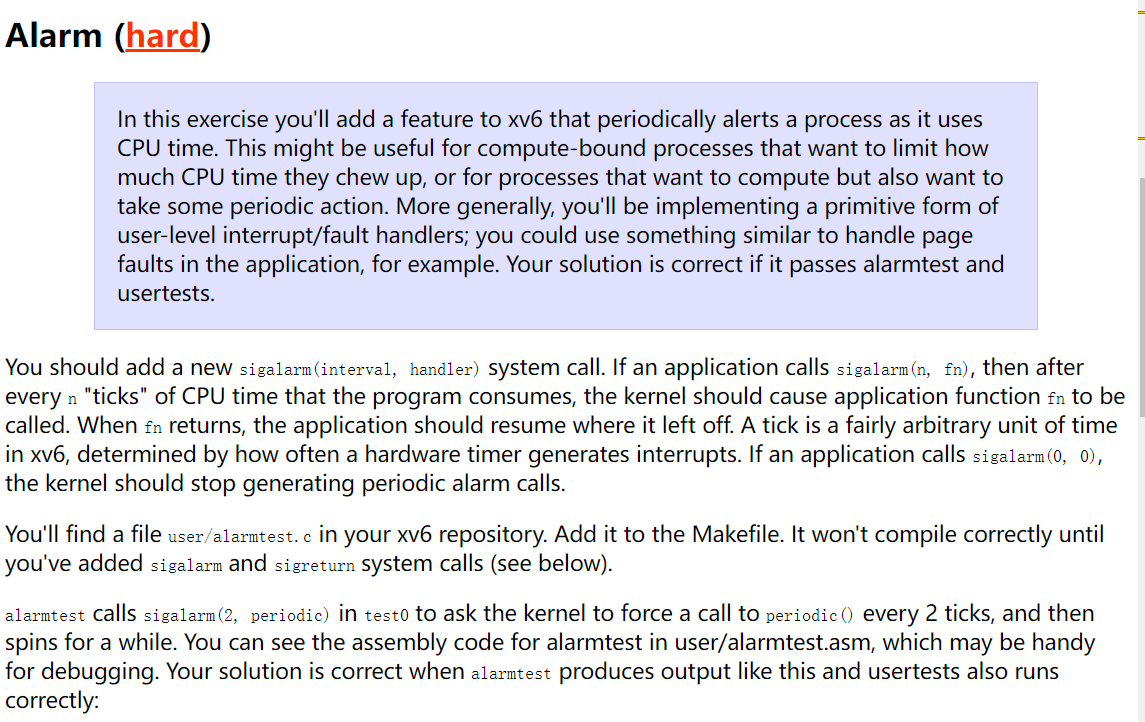
This lab is rather difficult to understand, especially sigreturn. Examine alarmtest.c carefully. A good understanding of the trap process is also necessary; if unfamiliar, see this article.
1 | void |
sigreturn means that execution may originally be inside this for loop and then abruptly begin executing periodic() because the interval elapsed. If periodic() calls sigreturn(), execution inside periodic() should stop and resume in the for loop. This video creator explains it clearly.
We can examine the tests in alarmtest.c in order and implement the calls according to their requirements.
test0: invoke handler
Get started by modifying the kernel to jump to the alarm handler in user space, which will cause test0 to print “alarm!”. Don’t worry yet what happens after the “alarm!” output; it’s OK for now if your program crashes after printing “alarm!”. Here are some hints:
In other words, first jump correctly into user mode to execute the handler. To preserve isolation, the function cannot simply run in the kernel. A crash after the jump is acceptable for now.
Recall the xv6 trap process. The epc register determines the address to which execution returns after a trap. Changing epc directly makes the return jump to the handler’s address.
How do we determine when the interval has elapsed?
RISC-V hardware—I am not entirely sure which hardware component—generates a timer interrupt every clock tick, and trap.c handles it.
We can count these interrupts to decide whether to jump. When required, directly replace epc in the trapframe in trap.c with the handler’s address.
Add the following fields to struct proc for every process:
uint64 alarm_tks;stores the handler interval; zero means disabled.void (*alarm_handler)();stores the handler address.uint64 alarm_tk_elapsed;stores the time elapsed since the handler last ran.
sys_sigalarm() stores its arguments in these fields. For now, sys_sigreturn() does nothing and simply returns zero:
1 | uint64 |
Because these fields have been added, initialize and release them appropriately in the process initialization function allocproc() and cleanup function freeproc().
First, the change in allocproc():
1 | …… |
Then freeproc():
1 | …… |
We can now implement the jump in usertrap() in trap.c:
1 | …… |
This successfully jumps to the handler and passes test0, although it predictably crashes afterward.
The main reason for the crash is that sys_sigreturn() has not yet been implemented, so after the handler finishes the process does not know where to return.
Passing test1 and test2 requires solving this problem.
test1/test2(): resume interrupted code
Chances are that alarmtest crashes in test0 or test1 after it prints “alarm!”, or that alarmtest (eventually) prints “test1 failed”, or that alarmtest exits without printing “test1 passed”. To fix this, you must ensure that, when the alarm handler is done, control returns to the instruction at which the user program was originally interrupted by the timer interrupt. You must ensure that the register contents are restored to the values they held at the time of the interrupt, so that the user program can continue undisturbed after the alarm. Finally, you should “re-arm” the alarm counter after each time it goes off, so that the handler is called periodically.
In short, execution must return to the correct location after the handler finishes.
Register values change while entering the kernel to handle traps and system calls. Merely restoring epc to the correct address is therefore insufficient: the complete register environment also needs to be backed up.
Add another struct trapframe field to struct proc to preserve the environment from before the handler:
1 | …… |
Naturally, it must also be allocated and released in allocproc() and freeproc().
In allocproc():
1 | …… |
In freeproc():
1 | if(p->alarmframe) |
usertrap() in trap.c can populate alarmframe. When the handler must run, back up the environment first and then redirect execution:
1 | if(which_dev == 2){ |
sys_sigreturn() restores the trapframe from alarmframe. This restores epc and all general-purpose registers, naturally leaving the handler and resuming the program’s original sequence:
1 | uint64 |
Running alarmtest again still does not pass every test.
Imagine that a handler executes extremely slowly. The specified number of ticks may pass again before the previous handler invocation finishes. If we replace epc again at that point, the handler restarts from its beginning. This is disastrous: epc keeps being reset and the handler can never finish.
The test program includes exactly this case:
1 | void |
We therefore need another field in struct proc, named alarm_state. A value of one means that the handler is currently executing. Even if another interval elapses, epc must not be changed to run the handler again while this state is active.
Because a new field has been added, allocproc and freeproc must be updated as well; I will not repeat those straightforward changes.
The more important change is in usertrap():
1 | if(which_dev == 2){ |
sys_sigreturn() also needs a change because calling it means that the handler is no longer running:
1 | uint64 |
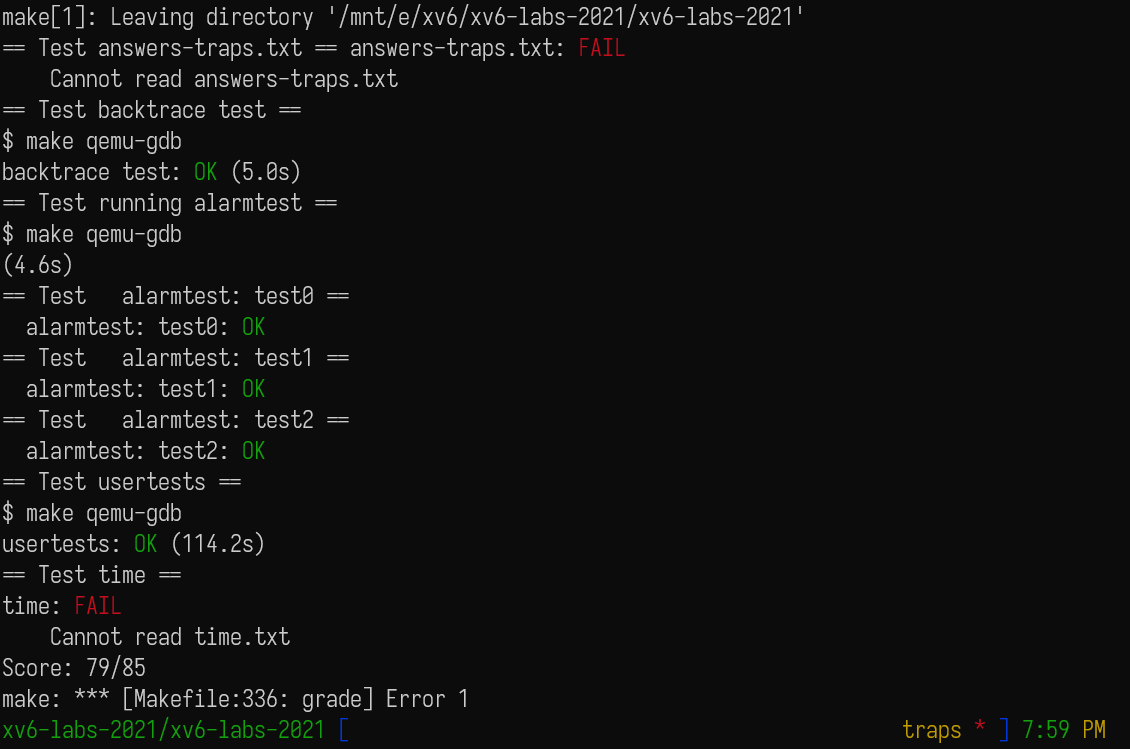
After these changes, the lab passes. I also wish everyone working on it an early AC:
Summary
More important than the exercises themselves is understanding the trap process in xv6. Even without completely understanding it, one can follow the instructions step by step and finish the lab. Understanding the mechanism is genuinely difficult, however, because it involves a great deal of unfamiliar RISC-V assembly and low-level knowledge. Once understood and implemented, it is hard not to admire the ingenuity of operating-system design.
Completing this lab also resolved many of my earlier questions about operating systems, including the principle behind the alarm exercise. At the same time, it revealed how shallow my understanding of assembly still is. See the xv6 notes in this article. I could never understand why userret and uservec exchange the sscratch register. After asking someone, I learned that it is a privileged register and cannot be manipulated using instructions such as ld and sd, although I still do not understand the reason for that design.



![[Stanford CS144] Lab 4 Record](/img/CS144/tcp%E7%8A%B6%E6%80%81%E6%B5%81%E8%BD%AC%E5%9B%BE.jpg)
![[Stanford CS144] Lab 0–Lab 3 Lab Notes](/img/CS144/sponge%E7%BB%93%E6%9E%84%E5%9B%BE.svg)