
Xv6 Notes: Page Tables and Traps
The content below was generated entirely by machine translation. Please verify its accuracy. If anything is unclear, consult the Chinese source version.
Book link, Chinese translation: https://github.com/duguosheng/6.S081-All-in-one
Chapter Zero
I could understand most of this chapter, but the example program involving a pipe confused me for a long time. I finally understood it, so I will record my interpretation here.
1 | int p[2];// p[0] stores the receiving descriptor and p[1] stores the sending descriptor |
First, note that file descriptors are shared between a parent and child process. In the example, pipe() appears to open another pipe after the child starts. In reality, the open descriptors are shared, so p[0] and p[1] in the parent and child refer to the same files, enabling communication between the processes.
According to Advanced Programming in the UNIX Environment, parents and children also share the following resources besides files, although I understand almost none of them.
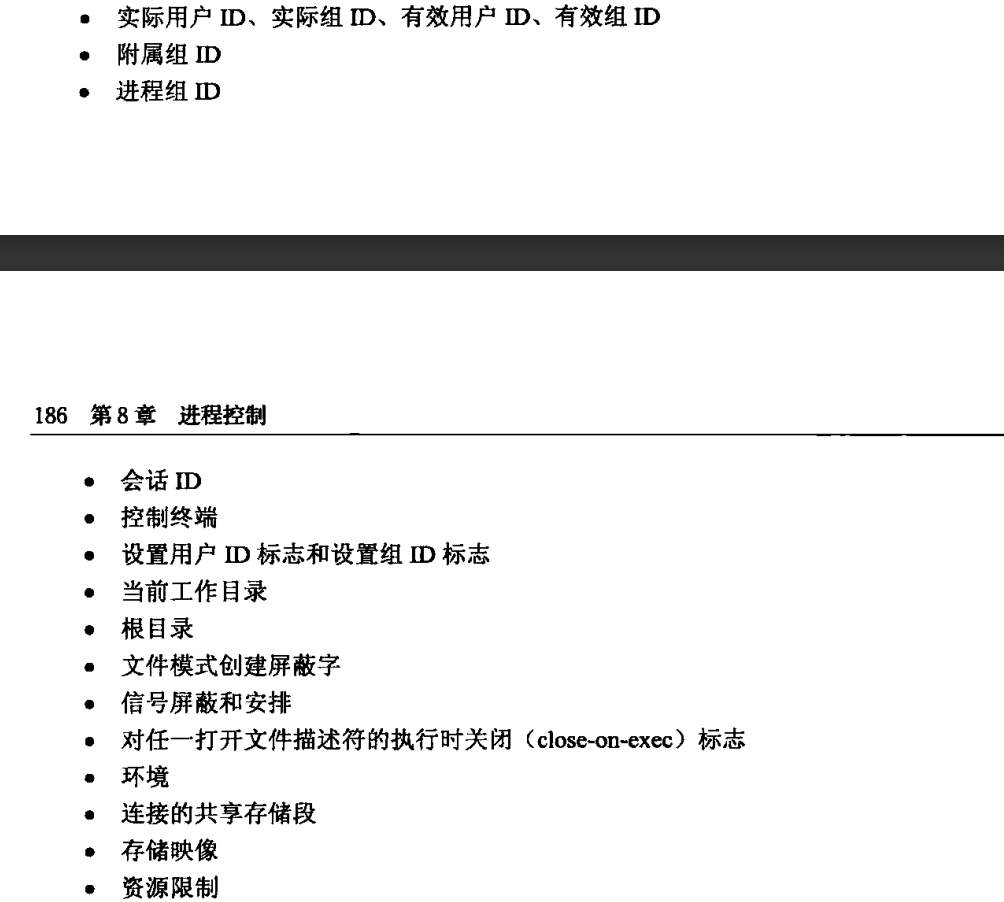
Their differences are:
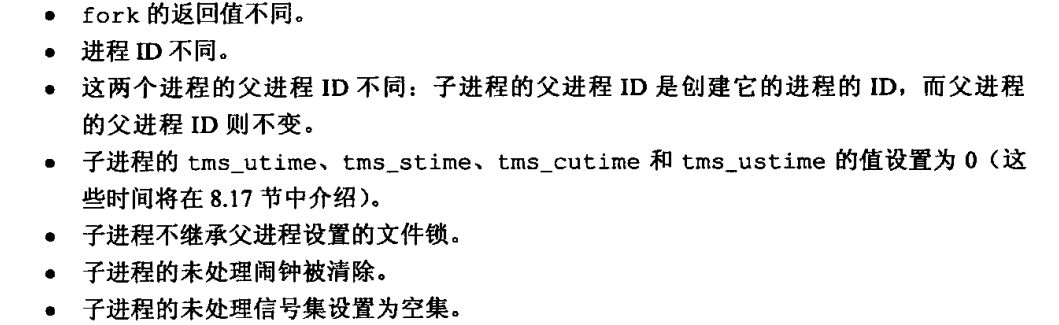
After the parent obtains the pipe descriptors through pipe(), it writes hello world to p[1], the sending end, and closes both ends. This part is easy to understand.
The child first calls close(0). Descriptor represents stdin. It then calls dup(p[0]) to duplicate descriptor p[0] onto another descriptor.
For example, after x = dup(y), x and y refer to the same file. Here, however, the return value from dup() is ignored. How do we know which descriptor receives the duplicate?
dup() searches descriptors in increasing order and selects the first closed one. The child closed stdin, descriptor , immediately beforehand, so dup() naturally redirects p[0] to stdin. Reading stdin is now equivalent to reading p[0].
The child next calls exec() to run wc, a command that counts words in a file. Its arguments contain argv[1] = 0, meaning that wc should count the contents of standard input.
An important property of exec() is that the system replaces the current process image with the new program. The process becomes the program passed to exec(), so a successful call never returns. To avoid replacing the current process, first call fork() and then invoke exec() in the child.
Because of the earlier dup(), standard input now points to p[0]. The data counted by wc is therefore what the parent sent through p[1]: the hello world from write(p[1], "hello world\n", 12).
Another point initially seemed strange. If the parent and child share file descriptors, are p[0] and p[1] not closed twice, causing a problem?
I found this article, which finally clarified it.
When
close()closes a file, it does not necessarily close the underlying file immediately. It findsf_countin thefilestructure and decrements it. The actual close occurs only whenf_countreaches zero. This well-known technique is reference counting.
Page Tables
I strongly recommend this article: https://zhuanlan.zhihu.com/p/351646541. It introduces xv6 page tables in great detail, and the discussion below refers to it extensively.
Introduction to page tables
A page table is a special data structure that implements memory virtualization in an operating system. It stores mappings from virtual addresses to physical addresses. The OS maintains a page table for every process, and a process can access physical memory only through that page table. Each process therefore appears to own all of the machine’s resources, and a memory leak in one process does not affect another process’s address space.
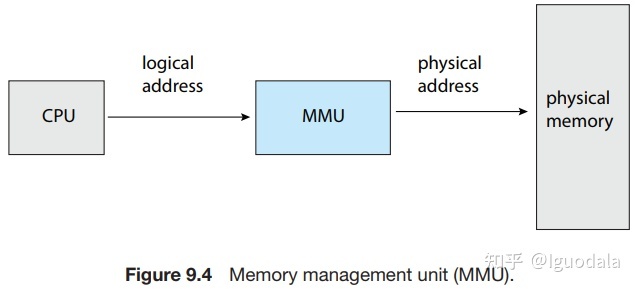
The CPU’s memory-management unit translates virtual addresses into physical addresses:
Besides strengthening process isolation, page tables and virtual addresses allow memory to be used more efficiently. In practice, finding one large continuous free region in physical memory is difficult. A program may request memory when the total free space is sufficient, yet no single contiguous region is large enough. As programs and data are repeatedly moved out of and loaded into memory, fragmentation increases. Page tables divide memory into pages, allowing contiguous virtual memory to map to discontinuous physical frames and thereby using space more efficiently.
Page tables and virtual memory also enable many other useful tricks, such as mapping one physical address at two virtual addresses simultaneously.
RISC-V page-table implementation
The simplest page-table implementation would resemble an array recording the virtual mapping for every physical page frame. In xv6, one frame is 4 KB.
Such a linear array itself consumes a large amount of storage. Most personal computers now have at least 8 GB of memory, so let us calculate the page-table space required for 8 GB.
With 4 KB frames, 8 GB contains page frames. Every frame needs a virtual-address mapping. Assuming a 64-bit machine, which an 8 GB computer must be, one address takes eight bytes. The page table therefore requires .
Sixteen megabytes would not itself be alarming on an 8 GB computer. The key problem is that every process needs a separate page table for its own virtual address space, with kernel and user page tables also separate. With fifty running processes, page tables would consume , which is clearly unacceptable.
To solve this problem, RISC-V and almost every other modern processor use multilevel page tables.
RISC-V uses three levels, which can be viewed as a three-level tree. The root has 512 entries, all of which occupy the root page. Entries at the remaining two levels can each lead to as many as 512 children, but the child tables need not exist.
These entries are formally called PTEs, Page Table Entries. Each PTE occupies 64 bits, of which 44 encode a physical page number and ten are flags describing the next page table or final memory page.
This explains why lower-level page tables need not all exist and why the hierarchy saves space. A flag in a PTE indicates whether the next table exists. If it does not, no storage is needed for that table. With a single-level page table, even an invalid mapping still requires its PTE to occupy a slot.
Multilevel page tables and PTE flags also make it possible to swap portions of page tables to disk and retrieve them only when needed, saving still more memory.
How is a virtual address translated after the CPU receives it?
First consider the virtual-address format used by xv6. Possibly for teaching convenience, xv6 uses only the low 39 bits; the upper 25 bits are reserved.
The CPU’s satp register points to the current root page table. The virtual address is interpreted relative to the table identified by satp.
The process is shown here:
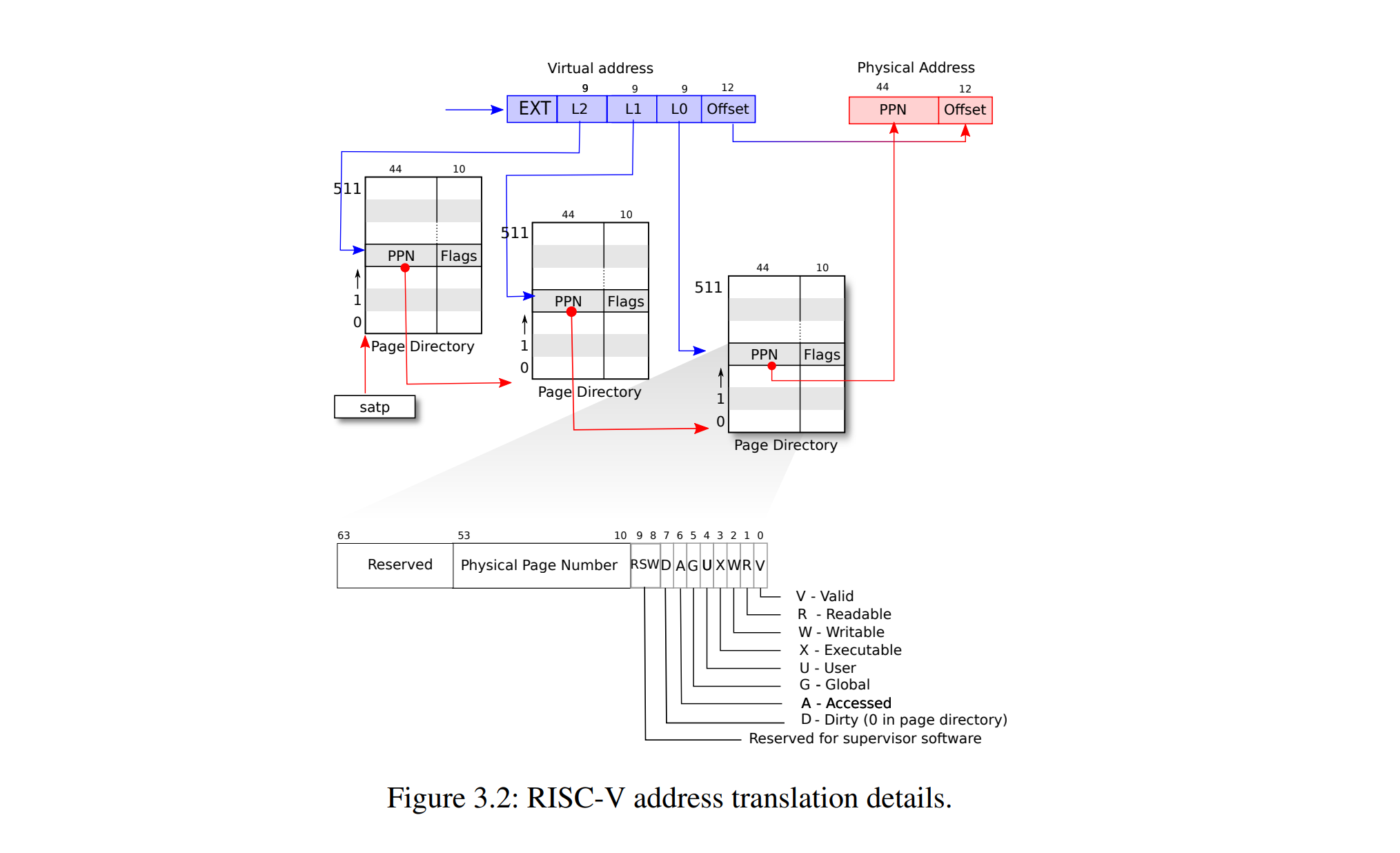
The first nine relevant bits select a PTE in the root table. That PTE contains a physical page number leading to the next-level table. Because there are three levels, this selection repeats three times. Each level consumes nine virtual-address bits. The remaining twelve bits are the offset inside the final 4 KB frame, since .
The lower part of the diagram shows PTE flags, including:
- V, valid, indicates that the page table or frame referenced by the PTE exists.
- R, readable, controls reads.
- W, writable, controls writes.
- X, executable, allows the memory contents to be executed as instructions.
- And others.
xv6 kernel virtual-memory layout
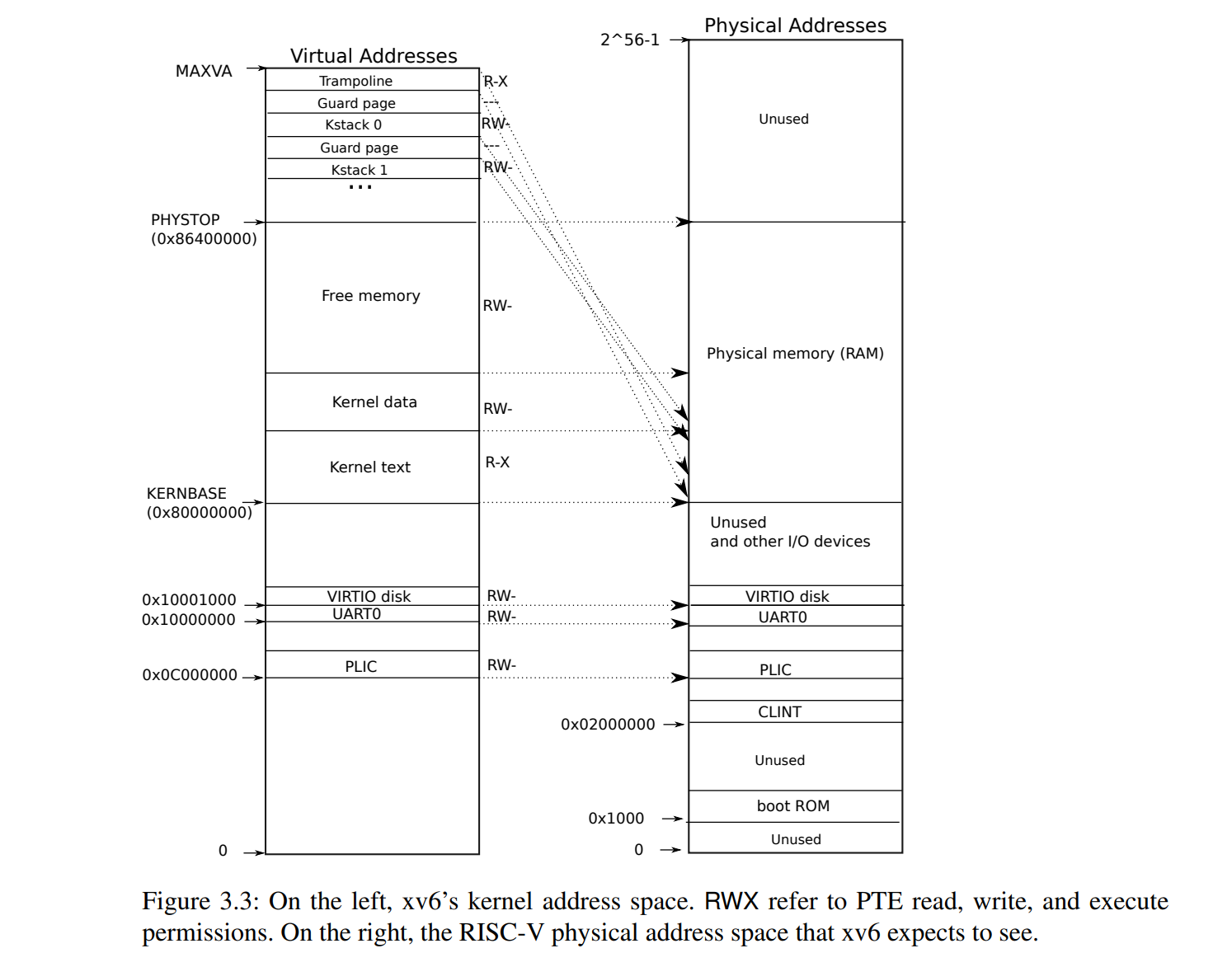
In QEMU, RAM begins at 0x80000000, KERNBASE. Addresses below it correspond to I/O devices such as the network card and interrupt controllers; reading and writing those memory-mapped addresses communicates with the devices. RAM ends at 0x86400000, PHYSTOP, for a total of 128 MB.
Except for two special regions, the kernel directly maps virtual addresses to the same physical addresses. This makes physical-memory manipulation convenient. The direct mapping also lets the kernel simulate MMU translation and read user data under a different page table through functions such as walk, discussed later.
The two regions not simply direct-mapped are the trampoline and kernel stacks.
The trampoline is mapped at the top of virtual memory. The same physical page is mapped at the top of every user page table. The reason becomes clear in the trap section.
Each kernel stack is mapped once near the top with guard pages and also exists in the middle direct-mapped region. This duplication supports the guard-page design.
A guard page prevents stack overflow. Its PTE lacks the V flag, so accessing it causes a page fault.
Kernel stacks are separated by guard pages. If a stack overflows into one of them, a fault occurs instead of silently accessing memory belonging elsewhere.
To save physical space, guard pages do not map to physical memory at all. This is an example of virtual memory’s flexibility: one physical address may be mapped at several virtual addresses, and a virtual address may map to no physical address.
xv6 user virtual-memory layout
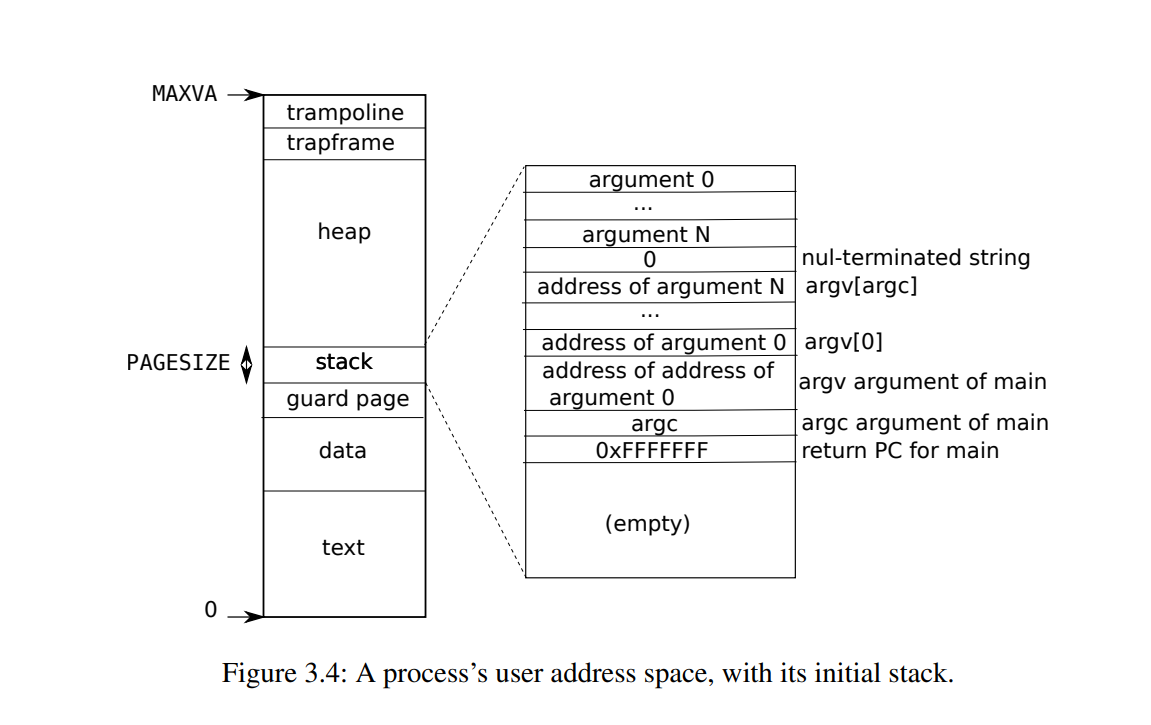
The user layout is mostly ordinary except for the trampoline at the top, whose physical page is also mapped into the kernel as described above.
Immediately below the trampoline is the trapframe, which stores register state during system calls and traps.
Some code
Postponed.
Traps
Purpose of the trap mechanism
Normally, a program executes in a roughly linear sequence, one instruction after another.
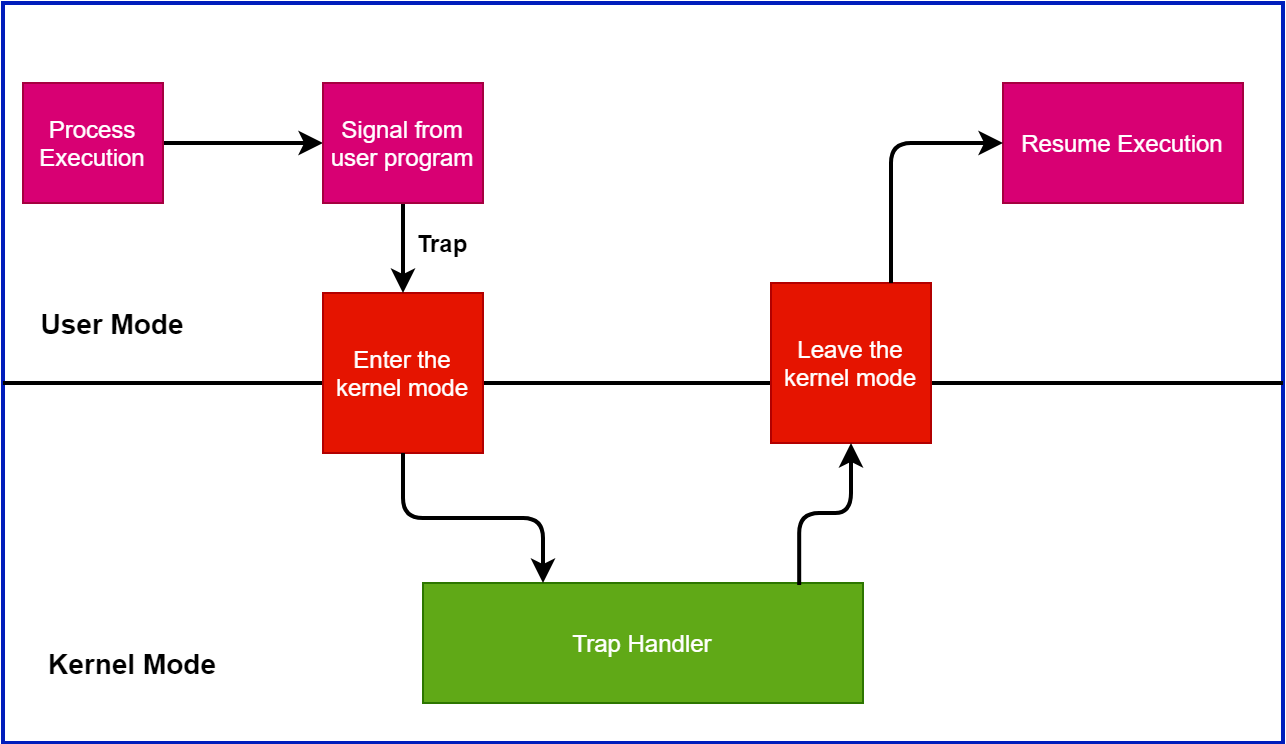
Certain events break this linear flow. A familiar example is a system call, which pauses the user program, enters the kernel to perform a service, and later returns to user mode.
xv6 calls this transition between user and kernel mode for special events a trap.
The following illustration[1] makes the name vivid: execution seems to fall into a pit and then climb back out.
Traps commonly arise from:
- System calls.
- Exceptions, such as division by zero.
- Device interrupts, such as timer interrupts.
Several registers participate in trap handling:
- stvec, Supervisor Trap Vector Base Address, contains the trap-handler address. On a trap, execution jumps to this address for further handling.
- sepc, Supervisor Exception Program Counter, preserves the original next program counter so execution can resume after the trap.
- scause, Supervisor Trap Cause, records whether the cause was a system call, exception, or interrupt.
- sscratch, Scratch Register for Supervisor Trap Handlers, generally stores the trapframe location.
- sstatus, Supervisor Status Register, holds flags shown here:
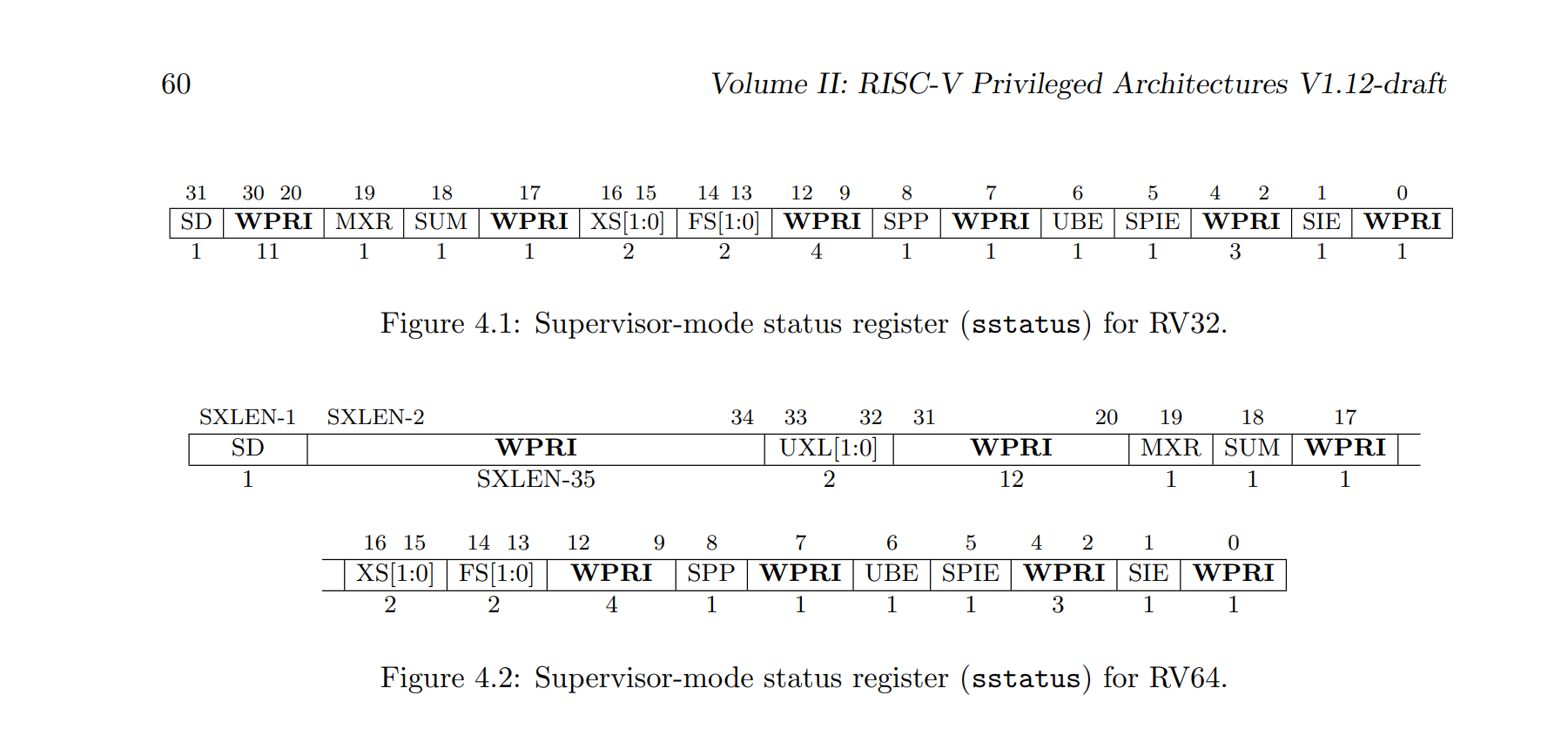 . Important bits include SIE, Supervisor Interrupt Enable, and SPP, Supervisor Previous Privilege. A clear SIE disables interrupts, which is necessary while handling a trap. SPP records whether the trap came from user or supervisor mode.
 - satp, Supervisor Address Translation and Protection, contains the current root page table, as mentioned in the page-table section.
Trapping from user mode
We will use a system call to illustrate xv6’s trap mechanism.
The Lab 2 record mentioned that ecall switches from user to kernel mode without explaining every intermediate step. After studying traps, the missing process becomes understandable.
The ecall instruction performs the following operations.[2]
- For a device interrupt—strictly not an ecall—do nothing if SIE is zero and interrupts are disabled.
- Clear SIE to disable interrupts, because the ecall itself produces a trap and two traps must not be handled simultaneously.
- Store the current mode in the SPP bit of sstatus.
- Change the current privilege to supervisor mode.
- Copy pc to sepc so the original location can later be restored.
- Copy stvec, the handler address, to pc, automatically jumping to the handler.
- Set scause to reflect the trap reason.
After ecall, execution jumps to the address in stvec. For a user trap in xv6, stvec points to uservec in kernel/trampoline.S; in kernel mode it points to kernelvec in kernel/kernelvec.S.
kernelvec is initially installed by trapinithart() from main():
1 | // set up to take exceptions and traps while in the kernel. |
The function writes the address of kernelvec into stvec.
Our example traps from user mode, so first examine uservec in kernel/trampoline.S.
uservec
1 | uservec: |
Several parts are especially important. The first is:
1 | csrrw a0, sscratch, a0 |
This instruction exchanges a0 and sscratch. From this point onward, a0 points to the trapframe. sscratch cannot be used directly by ordinary loads and stores because it is a privileged CSR; instructions such as sd and ld operate on general-purpose registers, while CSR instructions manipulate privileged registers.
Instructions such as sd ra, 40(a0) then copy register values into the trapframe in memory. Kernel C code accesses that memory through struct trapframe:
1 | struct trapframe { |
sd means store. It writes ra to the address in a0 plus a 40-byte offset.
All general registers except the original a0 have now been copied, so save a0 separately:
1 | # save the user a0 in p->trapframe->a0 |
Because of the earlier swap, sscratch currently contains the user’s a0. Copying it to t0 makes t0 equal to the original user a0, and sd t0, 112(a0) stores that value in the trapframe.
Next, completely switch the processor environment to the kernel. The process was using the user page table and stack pointer, so the corresponding registers must be replaced.
The following code performs the switch. ld, load, copies values from memory into registers:
1 | # restore kernel stack pointer from p->trapframe->kernel_sp |
An elegant detail is that the trampoline page, which contains uservec, has the same virtual address in the kernel and user page tables. The same physical page is mapped twice. Execution can therefore continue in uservec immediately after csrw satp, t1 changes the active page table.
The kernel context values in the trapframe—the kernel root page table, stack pointer, and so on—were saved when the kernel previously entered user mode.
They are assigned in usertrapret() in kernel/trap.c:
1 | // set up trapframe values that uservec will need when |
The final instruction of uservec is:
1 | jr t0 |
It jumps to the address in t0. Recall that immediately beforehand the following loaded the usertrap address:
1 | # load the address of usertrap(), p->trapframe->kernel_trap |
Thus, jr t0 transfers control to usertrap.
In summary, uservec:
- Saves the thread’s 32 general-purpose registers.
- Restores the kernel execution environment, including the kernel page table and stack pointer.
- Jumps to
usertrap.
usertrap
The code is:
1 | void |
It first checks whether the trap came from user or kernel mode:
1 | if((r_sstatus() & SSTATUS_SPP) != 0) |
SPP in sstatus records the previous privilege. If the trap came from the kernel, this user handler cannot process it and panics.
For a user trap, the function changes stvec to kernelvec:
1 | w_stvec((uint64)kernelvec); |
If an interrupt occurs while the kernel is running, its handling differs from a user trap and cannot use uservec.
1 | p->trapframe->epc = r_sepc(); |
sepc is saved because kernel processing may switch to another process, which can itself make a system call and overwrite the hardware sepc register. Saving it in the process trapframe preserves the original value across such switches.
Interrupts are enabled with intr_on() only after this state has been saved. A system call may take a long time, and enabling interrupts then lets the CPU service other work without losing the current process’s context.
The rest of usertrap dispatches according to the cause. A system call necessarily used ecall; after completing it, user mode should resume at the instruction following ecall, so the saved epc is advanced by four bytes.
Device interrupts are handled by devintr().
An unexpected exception marks the process as killed.
In summary, usertrap:
- Determines whether the cause is a system call, interrupt, or exception and performs the corresponding action.
- Changes stvec for possible kernel traps, and saves or adjusts sepc as required.
The final line calls usertrapret() to prepare the return.
usertrapret
1 | void |
The function first disables interrupts and changes stvec from kernelvec back to uservec.
It then writes kernel-context values into the trapframe so that the next user trap can restore the kernel environment, exactly as described in the uservec section:
1 | p->trapframe->kernel_satp = r_satp(); // kernel page table |
sepc is restored because the trap-return instruction copies it back into pc before resuming user execution.
The final lines are:
1 | // jump to trampoline.S at the top of memory, which |
This unusual function-pointer call jumps to another function in the trampoline page: userret.
In summary, usertrapret:
- Copies kernel-context data into the trapframe, including the kernel page table, stack pointer, and kernel trap handler.
- Restores stvec and sepc.
- Calls
userret.
stvec and sepc could conceptually be regarded as part of the same context-restoration process even though they are not ordinary trapframe fields.
userret
userret is essentially the inverse of uservec.
It receives two arguments, the trapframe address and user page-table value. Under the xv6 calling convention they arrive in a0 and a1.
1 | userret: |
The function restores all general-purpose registers from the trapframe, switches to the user page table, and finally executes sret.
Like ecall, sret performs several operations:
- Switches back to user mode.
- Copies sepc into pc.
- Enables interrupts.
User execution can then continue normally.
In summary, userret:
- Restores the 32 general-purpose registers.
- Restores the page table.
- Executes
sret.
Interrupts
To be updated. Postponed.
Thread Scheduling
Introduction
Modern operating systems generally provide multithreading, meaning that several tasks run apparently at the same time. The main reasons include:[3]
- Computers sometimes need to execute multiple tasks concurrently. Modern operating systems, for example, allow several users to log in and run their own processes.
- Multithreading can improve program structure and make code easier to understand and maintain. The prime-number exercise in Lab 1 uses multiple processes to improve structure.
- Multithreaded designs can better use modern multicore processors.
In practice, a processor usually runs different tasks for short time slices, switching rapidly among threads to create the appearance of simultaneous execution.
Multithreading provides these benefits but also raises difficulties:[3]
- How should execution switch between threads?
- A switch must save and restore thread state, so exactly what information must be preserved?
- A compute-intensive thread may run for a very long time without voluntarily yielding. How can the operating system regain control of the processor?
The following discussion uses a switch from one user process to another to explain xv6’s implementation.
This diagram from the xv6 book summarizes the process-switching path:
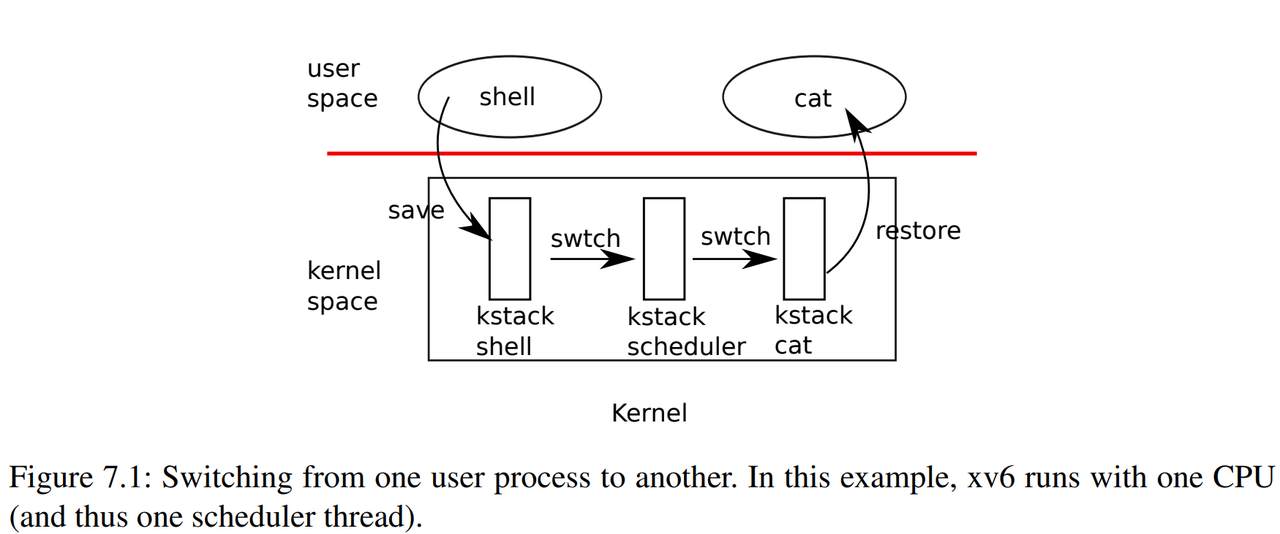
Code
Interrupt
Most process switches begin with a hardware timer interrupt. xv6 configures the RISC-V processor to generate such interrupts periodically, notifying the kernel that the current process has occupied the CPU long enough and should be switched out.
If the CPU is executing a user program when the interrupt arrives, as in the diagram, usertrap() in kernel/trap.c handles it:
1 | …… |
When the interrupting device is the timer, it calls yield():
1 | // Give up the CPU for one scheduling round. |
Apart from locking and unlocking the process, yield() calls sched().
sched() is itself largely a wrapper around swtch():
1 | // Switch to scheduler. Must hold only p->lock |
Switching
The checks and panics at the start validate the state; the essential operation is swtch(). Its name lacks an i because switch is a C keyword.
swtch is implemented in assembly in kernel/swtch.S:
1 | # Context switch |
It saves selected current registers into old->context, loads values from new->context, and assigns them to the processor registers.
Its actual purpose is to switch kernel-thread context, for example from the shell process’s kernel stack to the scheduler stack shown in the diagram.
At this point, it may seem strange that swtch() changes thread context but saves only fourteen registers rather than all 32 as the trapframe does.
Under the xv6 calling convention, s0 through s11 are callee-saved. The remaining general registers are caller-saved.
Those remaining registers can already be recovered from the stack through offsets from sp, so swtch() has no reason to save them again.
For the exact caller- and callee-saved classifications, see this RISC-V documentation table:
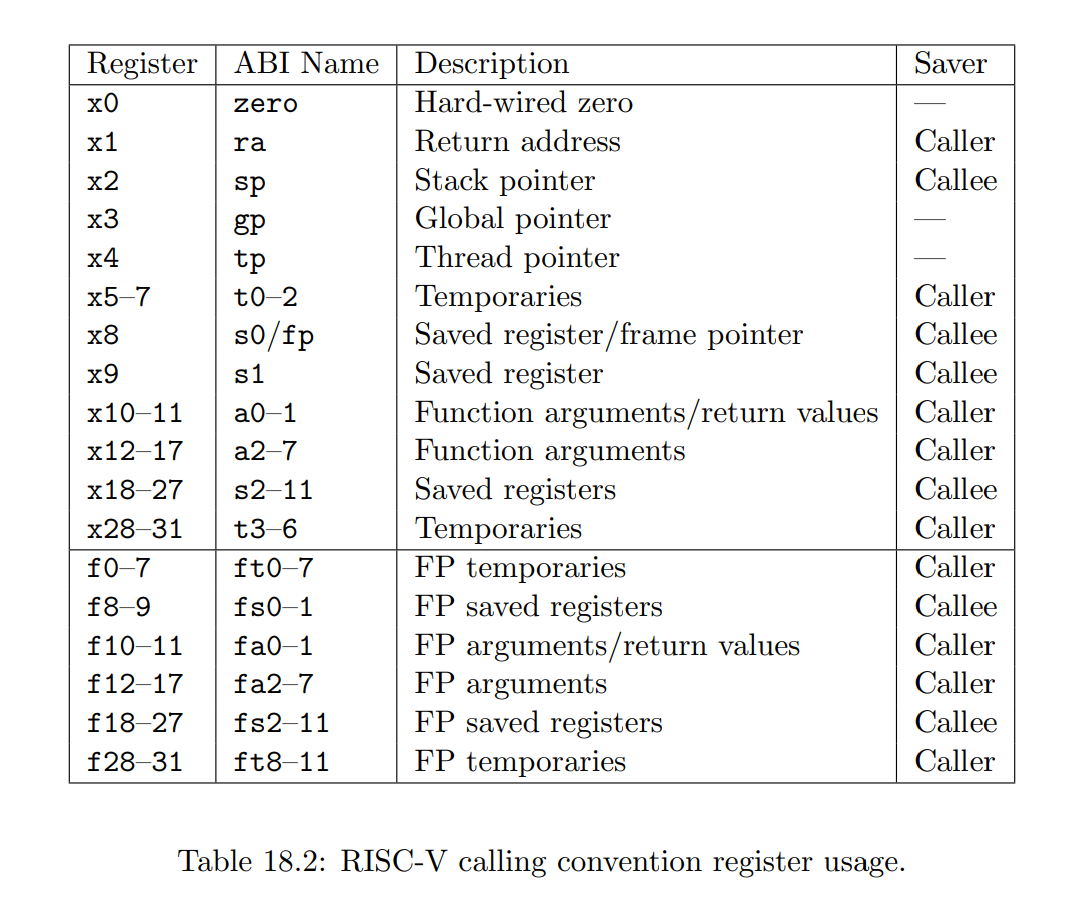
The saved and restored ra and sp deserve particular attention.
ra determines where swtch() returns, while sp determines the active stack. Thus, after the switch, the function does not necessarily return to the final statement in the current invocation of sched(). It returns to the location stored in mycpu()->context.ra using the restored scheduler stack.
Scheduling
The ra in mycpu()->context points into scheduler(), matching the process shown in the diagram:
1 | // Per-CPU process scheduler. |
Why does it return there? Examine kernel/main.c:
1 |
|
After initialization, each CPU enters scheduler(). When scheduler() finds a RUNNABLE process, it calls swtch(&c->context, &p->context).
At that moment, sp and ra refer to the scheduler function, so saving them in mycpu()->context records the address immediately after the scheduler’s swtch().
The behavior feels like a portal and time machine. Calling swtch() in one location returns from a call made much earlier, in computer terms, at another location. The call and return are separated: a call to swtch returns through the saved context of a different swtch call.[4]
After sched() calls swtch(), execution resumes after the swtch() inside scheduler(). The scheduler searches for another RUNNABLE process and switches to it.
Before switching, it performs:
1 | p->state = RUNNING; |
This changes the process state to RUNNING and records p as the current process of the CPU.
After the switch, myproc() can identify the process currently running on that CPU:
1 | // Return the current struct proc *, or zero if none. |
It simply returns the proc field from the CPU structure.
As described above, swtch() behaves like a portal. In scheduler(), switching to process p returns to the earlier swtch() invocation inside p’s sched():
1 | // Switch to scheduler. Must hold only p->lock |
In summary, swtch() called from sched() returns inside scheduler(), while swtch() called from scheduler() returns inside sched().
After a timer interrupt, control reaches scheduler(), finds a runnable process, and restores that process’s context through swtch().
This explains the general process-switching and scheduling path, although several details remain.
Locks
Both yield() and scheduler() perform lock operations. Why are they necessary?
First, trace their sequence. scheduler() acquires p->lock and calls swtch() to switch context. The target sched() returns into yield(), which releases p->lock.
In the opposite direction, a timer interrupt makes yield() acquire the process lock, and sched() calls swtch(), returning after the scheduler’s swtch(). The scheduler then releases the process lock.
Like the split call and return of swtch(), acquisition and release of the process lock occur in different functions. A lock acquired by yield() is released by scheduler(), and one acquired by scheduler() is released by yield().
The locked interval exactly covers the context-switch operation because the process structure is in an unstable state while a switch is underway.[4]
For example, yield() marks the process RUNNABLE before the scheduler has actually switched it out. Another core running scheduler() could observe that RUNNABLE state and begin executing the same process, leaving two CPUs simultaneously running one process—a severe error.
With the lock held, another core encountering this incompletely switched RUNNABLE process blocks while trying to acquire its process lock. It cannot run the process until the original CPU completes the switch.
Lock acquisition also disables interrupts, preventing another timer interrupt during the switch.
First scheduling
The preceding code shows that swtch() in scheduler() normally returns inside sched() because the process previously entered sched() after a timer interrupt and saved that context.
A newly created process has never experienced such an interrupt and has never called sched(). Immediately after initialization, main.c enters scheduler(). Where does the scheduler’s first swtch() for a new process go?
The answer appears in allocproc():
1 | // Look in the process table for an UNUSED proc. |
When the process is created, its saved ra is initialized to forkret. The first time scheduler() selects it, swtch() therefore jumps to forkret() rather than returning inside sched().
forkret() simply prepares a direct return to user space:
1 | // A fork child's very first scheduling by scheduler() |


![[Stanford CS144] Lab 4 Record](/img/CS144/tcp%E7%8A%B6%E6%80%81%E6%B5%81%E8%BD%AC%E5%9B%BE.jpg)
![[Stanford CS144] Lab 0–Lab 3 Lab Notes](/img/CS144/sponge%E7%BB%93%E6%9E%84%E5%9B%BE.svg)