
[MIT 6.s081] Xv6 Lab 1: Utilities Record
The content below was generated entirely by machine translation. Please verify its accuracy. If anything is unclear, consult the Chinese source version.
Update on 2022/9/14: I recently put the lab code on GitHub. If you need a reference, you can find it here:
https://github.com/ttzytt/xv6-riscv
The different branches contain the different labs.
Before beginning, I have to complain: why is the style of the xv6 source code so strange? The return type of a function is not even on the same line as the function name.
1 | int |
Like this…
I also recommend disabling dark mode with the gear icon in the lower-right corner while reading, because some images contain black text that is difficult to see in dark mode.
Lab 1: utils
Lab instructions: https://pdos.csail.mit.edu/6.828/2020/labs/util.html
sleep
Implement asleepcommand whose only argument is the amount of time to sleep.
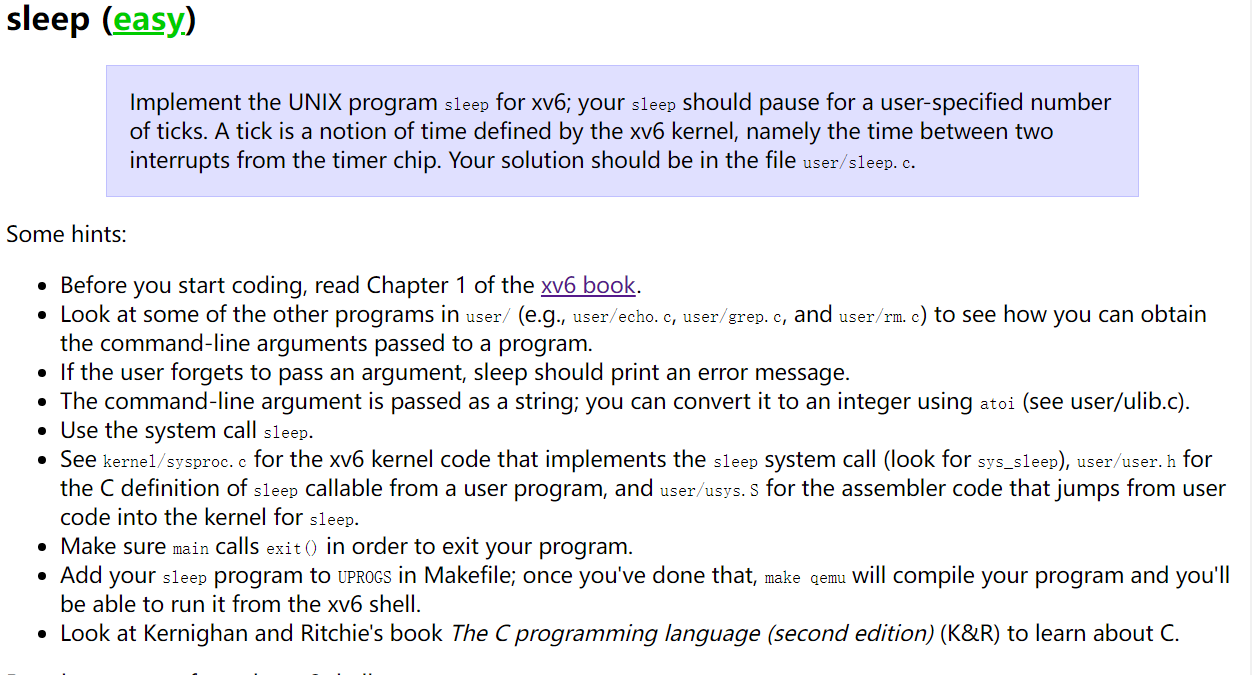
Because the required system call already exists, the implementation is fairly simple: call the provided sleep system call directly.
The only detail to remember is that #include kernel/types.h must appear before #include user/user.h. The former contains several type definitions that user.h needs.
1 |
|
The included kernel/fd_types.h is a file I added myself. Its source is shown below; it simply defines the identifiers for the input and output files so that I do not forget them:
1 |
|
pingpong
Create a child process and communicate between processes through pipes. The child and parent each send one message to the other through a pipe. After receiving a message, the parent prints “ping” in the terminal, while the child prints “pong” after receiving its message.
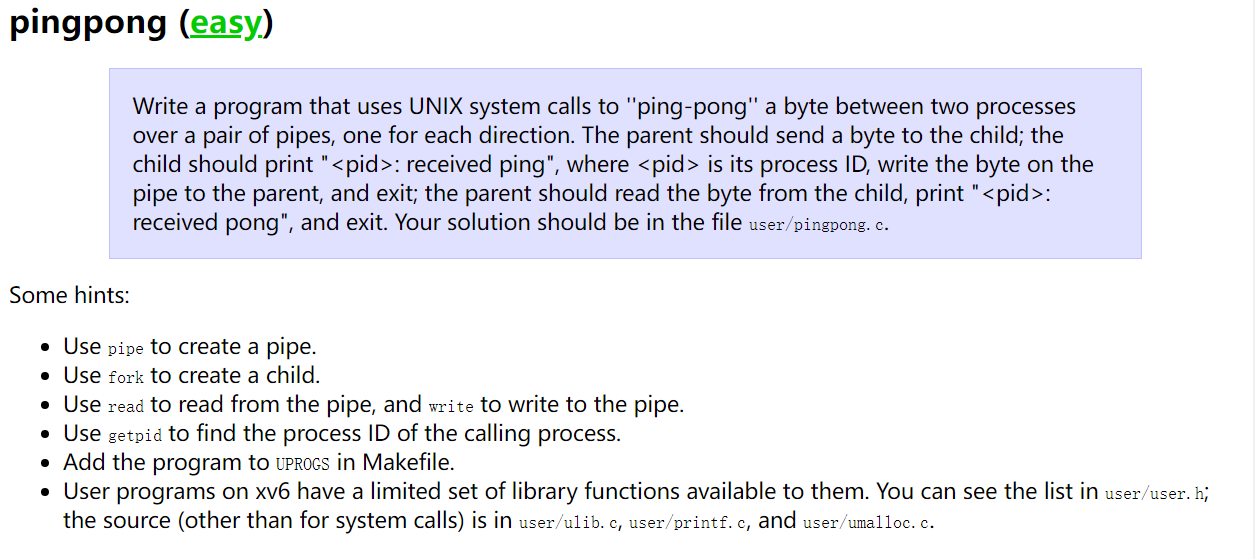
After creating the child, first let the parent process send some information. The parent can then call wait(). The child first outputs “pong” and sends a message to the parent. Finally, the parent receives that message and outputs “ping”.
This process looks simple, but I initially did not understand the properties of pipes and therefore used them incorrectly. A pipe is generally used for one-way communication. Because this lab requires the parent and child to communicate in both directions, two pipes should be created.
This Zhihu answer explains the implementation of pipes quite clearly:
Saying that data can move in only one direction means FIFO. Linux therefore constructs a circular queue internally. More specifically, it allocates a buffer as the entity of the anonymous pipe file created by
pipe(). The buffer has two pointers, one for reading and one for writing. The read pointer cannot advance past the write pointer; otherwise the writer is awakened and the reader sleeps until the required number of bytes has been read. Similarly, the write pointer cannot advance past the read pointer; otherwise the reader is awakened and the writer sleeps until the required number of bytes has been written.
I also initially omitted wait(), which caused problems such as garbled output. We do not know whether the system will run the child or the parent first. Both processes may output “ping” and “pong” at the same time, causing the two words to become mixed together.
1 |
|
primes
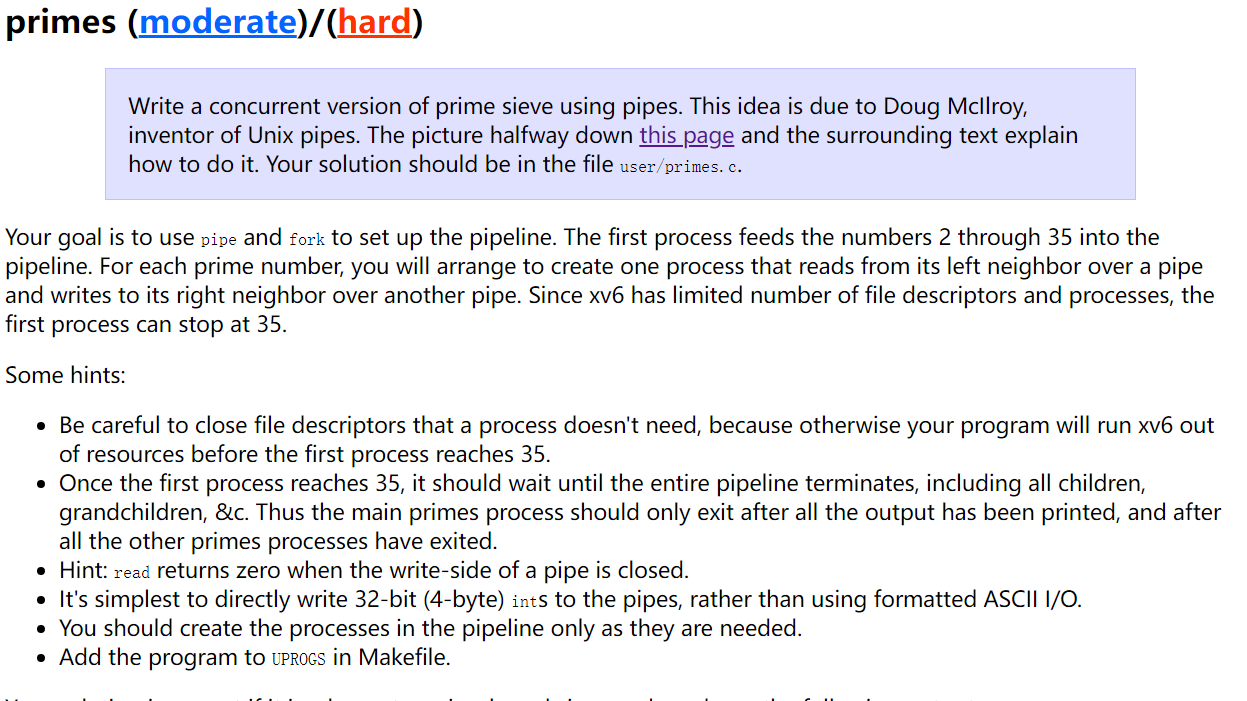
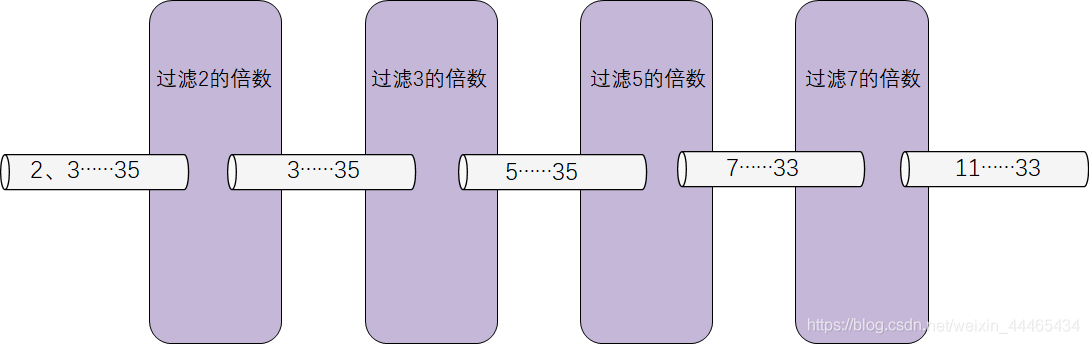
Create multiple child processes to find prime numbers. Each child filters from the numbers received from the preceding process all multiples of one prime, then passes the remaining numbers to another child. Because of xv6’s performance limitations, it is sufficient to output the primes up to . The diagrams below provide a more detailed explanation.
 |
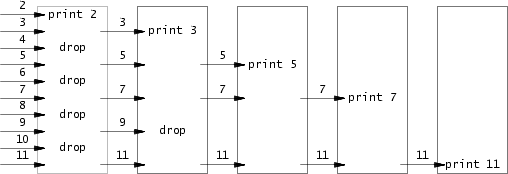 |
This is the strangest prime sieve I have ever seen, but it actually fits the definition of “sieving” very well. Each process acts as a particular sieve that filters out multiples of one prime. After the numbers have passed through many layers of sieves, the final primes remain. Note that the first number passed to the next process must be prime, because it is not divisible by any smaller number—or, more precisely, any smaller prime. If it were divisible, an earlier sieve would already have removed it.
One point to remember is that after fork(), the child begins executing at the line following fork(). After all, fork() copies all of the parent’s state, including the PC register. (This is actually common knowledge and hardly worth noting. I simply did not know it before and made an extremely foolish mistake.)
Another point is that a pipe must be closed promptly after use. xv6 has limited resources, and leaving pipes open indefinitely may crash the program.
1 | int main(int argc, char* argv[]) { |
In the parent process of the main function, we first create an initial array containing the integers from through . We then call send_to_next(), whose purpose is to send the contents of an array through a pipe to the next process.
It is implemented as follows:
1 | void send_to_next(int outpp, int msg[], int msg_len) { |
The child process created in the main function calls child_proc(). The function’s only argument is the receiving end of a pipe, through which the child receives the numbers not removed by the preceding sieve.
1 | void child_proc(int pp[2]) { |
Inside child_proc(), the first received number is treated as prime for the reason explained earlier.
That prime and the filter() function are then used to eliminate all of its multiples. The implementation of filter() is:
1 | int* filter(int num, int inpp, int* outlen) { |
After filtering the multiples of the current prime, we can create another process and pass the remaining numbers to it. The child process calls child_proc() again:
1 | if(pid == 0){ |
Notice that the pipe passed to child_proc is not the original pp, but the newly created child_pp. This is necessary because one process must both read the numbers sent by the preceding process and send its filtered numbers to the following process.
A pipe carries data in only one direction. If we used only one pipe, then while receiving data from the preceding process, the current process could not close the sending end because it would need that end later to pass filtered data to the next process.
However, if the sending end of a pipe has not been closed, a read() from that pipe blocks. It waits for new data because the system cannot know whether another message will later arrive from the sending end. Closing the sending end is the only indication that transmission has finished and no additional data will arrive.
At the beginning, both the child and parent inherit an open copy of each pipe end. In other words, two processes have the sending end open. If only one process closes its copy, reading from the receiving end still blocks because the sending end has not truly been closed everywhere.
This explanation may still be unclear. The following diagram shows the entire process more directly:
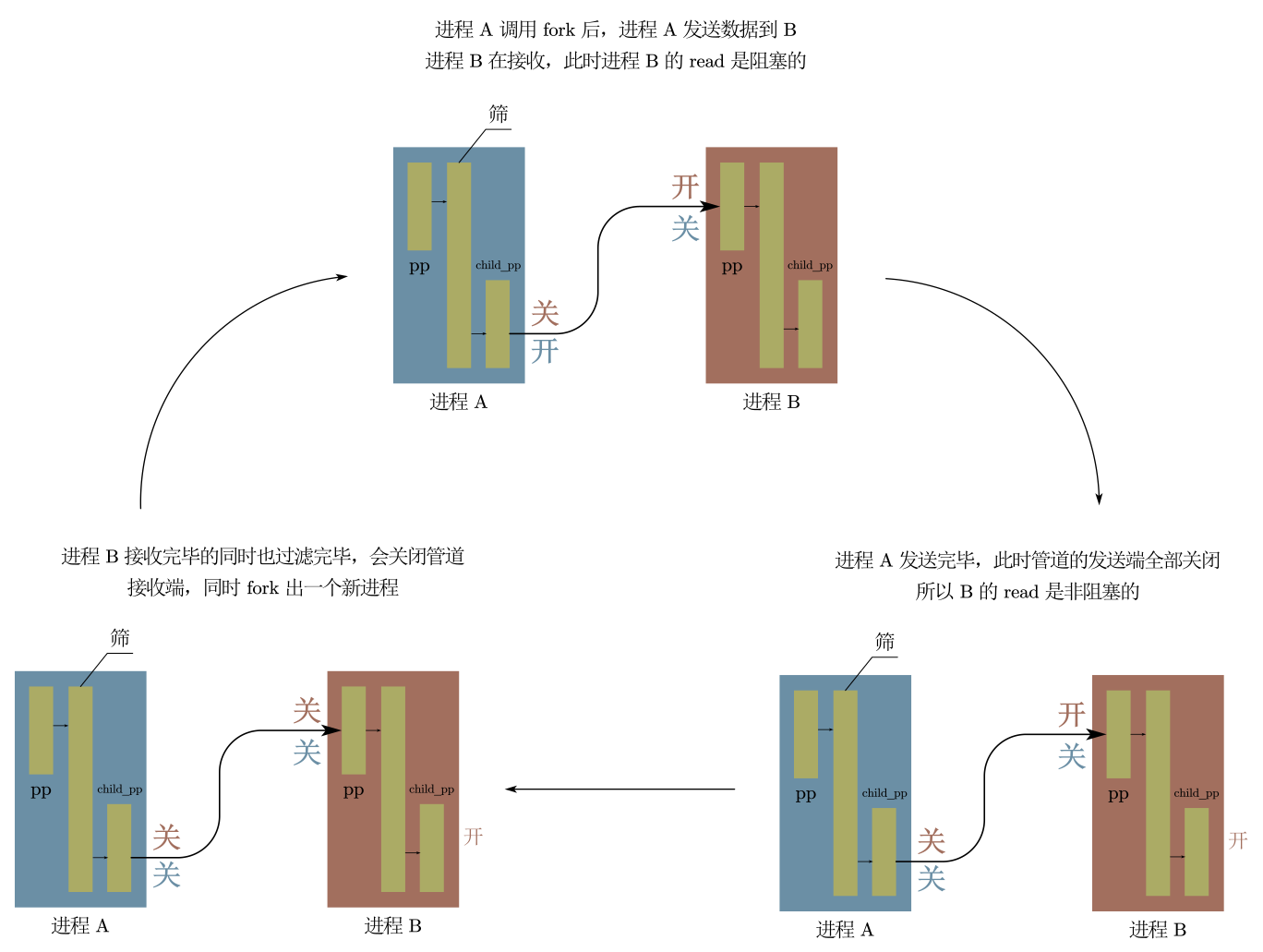
There is another detail. When the child executes child_proc, the parent must call wait(); otherwise a zombie process may be produced.
That is, the parent may finish and call exit() to release its space while the child is still running.
Contrary to what intuition might suggest, when the child later calls exit() and releases its resources, it does not disappear completely from the system. Its process descriptor remains, solely to provide status information to its parent.
The parent must therefore call wait() to release the last remaining resources of that process, including its process identifier and slab cache entries. The call blocks the current parent until one of its children exits.[3]
Zombie processes consume resources such as process IDs and file descriptors and are therefore harmful.
Omitting wait() also causes the program to fail the supplied unit test, ./grade-lab-util—which is how I discovered that my program was wrong. During the test, the process never terminates, so the grader reports a timeout.
The same behavior occurs in the shell. Even after all primes have been printed, the shell never displays $, showing that the process has not finished.
I am still not entirely sure why a zombie process causes this particular behavior. If you know, please explain it in the comments.
The complete code follows and refers to
DEBUG and dbg_arr_i32 are debugging functions or macros I added to kernel/dbg_macros.h as follows:
1 |
|
find
Implement thefindcommand. It searches a directory for every file with a specified name and prints the absolute path of each matching file.
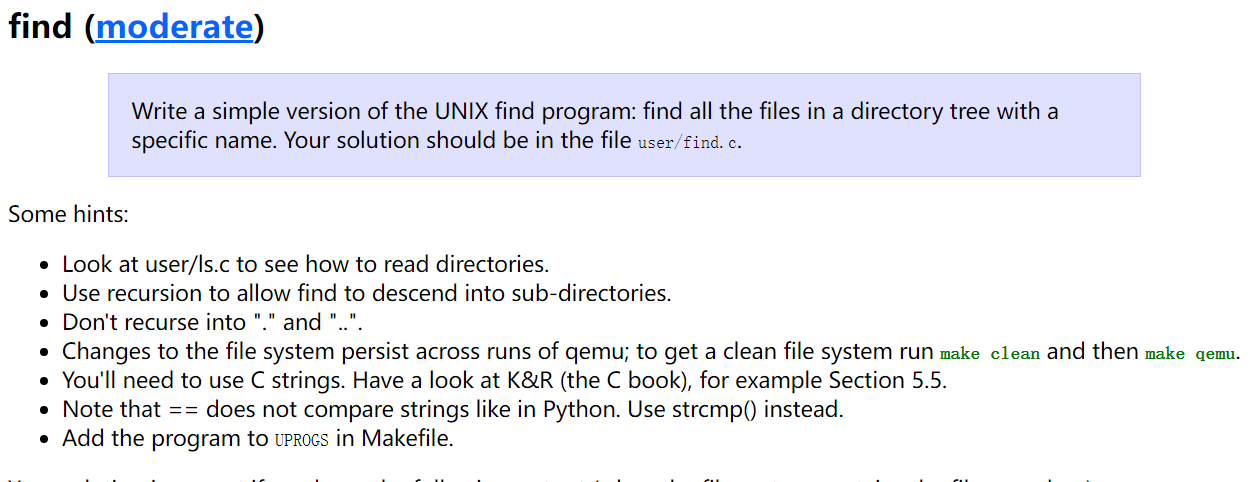
The implementation can refer to ls.
It is essentially a DFS. If the current path refers to a directory, recursively visit every file and subdirectory inside it.
To obtain the entries stored in a directory, directly call read() on that directory. The returned object is a dirent structure.
The structure is defined as:
1 | struct dirent { |
Its inum field is the inode number. It is different from a file descriptor: multiple file descriptors can refer to one file, but every file has a unique inum.
Remember to skip the . and .. entries inside a directory; otherwise the recursion becomes an infinite loop.
Using the dirent structure, we can append name directly to the current path and recursively pass the resulting path to the next call.
The functionality required here differs from ls, so its implementation can actually be simplified further.
Because ls is not recursive, it must initially call fstat() on a file entry to determine whether it is a directory or a file. If it is a directory, ls then calls stat() to output information for every entry inside that directory.
Both stat() and fstat() obtain information about an inode. Their only difference is that fstat() accepts a file descriptor, whereas stat() accepts a path.
Because find is recursive and already obtains a descriptor with open(), it needs only one call to fstat() and does not need stat().
1 |
|
xargs
Implement the UNIXxargscommand.
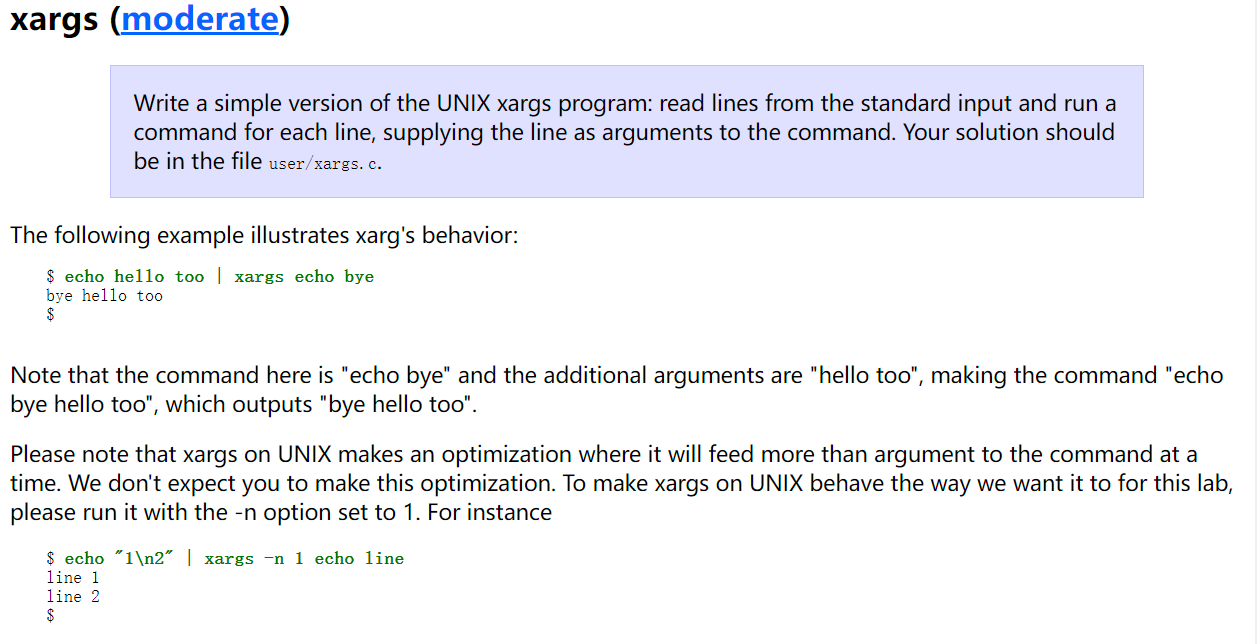
At first, I spent a long time without understanding what this command did. It simply passes data from standard input as arguments to a command. The first argument to xargs is the name of another command. All subsequent arguments, together with data read from standard input, must be supplied as arguments when that command is executed.
xargs exists because many commands cannot read pipe input directly as command-line arguments. A shell pipe connects the standard output of the preceding command to the standard input of the next one. We therefore need to read this input and convert it into arguments for another command.
For example, consider echo hello too | xargs echo bye. The pipe writes the two strings “hello” and “too” to the standard input of xargs. It must read those strings and combine them with the argument “bye”, then execute the second echo with all three as arguments.
First, we identify separate arguments by spaces and newline characters, split them, and store them in another character array named std_args.
Next, create a character-pointer array named arg2pass for the arguments passed to exec(). Put the command name, argv[1], into arg2pass first, followed by the remaining elements of argv, and finally append the elements of std_args.
1 |
|
Summary
First, here is a picture showing that the lab passes. I also wish everyone working on this lab an early AC.
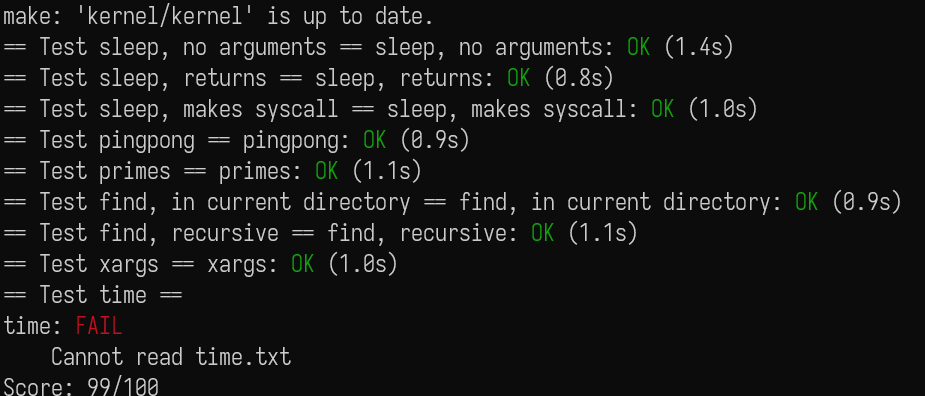
Most parts were not very hard to devise. Debugging consumed a great deal of time, however, making my progress extraordinarily slow. After years of using the C++ STL, I am no longer particularly familiar with C, and debugging C strings wasted especially much time. I should practice both debugging techniques and the C language in the future.
- 1.↩
1
2
3
4
5
6
7
8
9
10
11
12
13
14
15
16
17
18
19
20
21
22
23
24
25
26
27
28
29
30
31
32
33
34
35
36
37
38
39
40
41
42
43
44
45
46
47
48
49
50
51
52
53
54
55
56
57
58
59
60
61
62
63
64
65
66
67
68
69
70
71
72
73
74
75
76
77
78
79
80
81
const int MAX_P = 35;
// #define FDEBUG
enum PIPE_END { REC = 0, SND = 1 };
void send_to_next(int outpp, int msg[], int msg_len) {
// Send to the next child process
for (int i = 0; i < msg_len; i++) {
write(outpp, msg + i, sizeof(int));
}
}
int* filter(int num, int inpp, int* outlen) {
// Filter all multiples of num from the inpp pipe and return the filtered array
(outlen) = 0;
// len is the number of values remaining after filtering
int out = (int *)malloc(MAX_P * sizeof(int));
int ret = 0;
do {
ret = read(inpp, out + (*outlen), sizeof(int));
// ret is the number of bytes read
if (out[(outlen)] % num != 0 && ret > 0) {
(outlen)++;
}
} while (ret > 0);
return out;
}
void child_proc(int pp[2]) {
int child_pp[2];
pipe(child_pp);
int prime;
int len = read(pp[REC], &prime, sizeof(int));
DEBUG("len: %d\n", len);
if(len == 0){
printf("OK");
exit(0);
return;
}
printf("prime %d\n", prime);
int outlen;
int filtered = filter(prime, pp[REC], &outlen);
dbg_arr_i32(filtered, 0, outlen);
DEBUG("outlen: %d\n", outlen);
close(pp[REC]);
int pid = fork();
if(pid == 0){
    close(child_pp[SND]);
    child_proc(child_pp);
} else {
close(child_pp[REC]);
send_to_next(child_pp[SND], filtered, outlen);
close(child_pp[SND]);
wait(0); // wait releases the child's process ID and other resources
exit(0);
}
}
int main(int argc, char argv[]) {
int pp[2];
pipe(pp);
int pid;
pid = fork();
if (pid == 0) {
close(pp[SND]);
child_proc(pp);
} else {
int init_num[MAX_P];
int idx = 0;
for(int i = 2; i <= MAX_P; i++){
init_num[idx++] = i;
}
close(pp[REC]);
send_to_next(pp[SND], init_num, idx);
close(pp[SND]);
wait(0);
}
exit(0);
} - 1.https://blog.csdn.net/weixin_44465434/article/details/111524650 ↩
- 2.https://swtch.com/~rsc/thread/ ↩
- 3.https://segmentfault.com/a/1190000038820321 ↩



![[Stanford CS144] Lab 4 Record](/img/CS144/tcp%E7%8A%B6%E6%80%81%E6%B5%81%E8%BD%AC%E5%9B%BE.jpg)
![[Stanford CS144] Lab 0–Lab 3 Lab Notes](/img/CS144/sponge%E7%BB%93%E6%9E%84%E5%9B%BE.svg)